Scarlet Robin in the Mt Lofty Ranges

Male Scarlet Robin

Male Scarlet Robin

Last night a local television channel (ABCTV1) showed a special item on the endangered Scarlet Robin in the Mt Lofty Ranges here in South Australia. I can recall only ever seeing this Robin once in the Adelaide Hills. The photo above does not do the species justice; it is a beautiful bird. It is not at all common here in in our state.

The main thrust if the short documentary was to highlight the plight of this lovely bird, and many other species of small bush birds. With the massive clearances made over the last 150 years for agriculture there is little room left for this little bird, and many others like it. One of the speakers claimed that only 7% of original bushland was still available for such birds as the Scarlet Robin. It is facing extinction in this part of  Australia.

Related articles:

Baby Magpie learns to fly – sort of

Australian Magpie (juvenile)

Australian Magpie (juvenile)

Our resident family of Australian Magpies has been busy feeding two babies in the nest over recent weeks. The mother bird has been bringing tasty meals to the young ones who put up a great begging performance if she is too slow about it.

Meanwhile the male patrols the territory, seeing off any intruders – like the Brown Falcon who came visiting recently. (Details of that incident will follow tomorrow.)

Australian Magpie (juvenile)

Australian Magpie (juvenile)

Last week one of the babies decided to test out his wings. He left the nest – not at all gracefully and very hesitatingly. It was all downhill and into the wind until he came to the pear tree in the orchard, where he decided to cling to a branch for all he was worth.

I was watching this all happen from the verandah where we were having a well earned cuppa. I raced inside for the camera. Over the next five minutes I was able to carefully creep right up to about three metres away without disturbing the little fellow – still clinging desperately to the branch where he landed.

Australian Magpie

Australian Magpie

I quickly retreated, but not before mother bird came investigating to see if I was behaving myself. Soon she was happy to resume looking for the next tasty morsel to feed junior.

Later I was watching from the house. The baby had moved to another tree. He decided the fly down to where the mother bird was searching for food. The flight was okay – it was the landing that undid him. He landed on his face. Some techniques obviously need a little practice.

Related Articles:

Australian Magpie

Australian Magpie

The Magnificent Osprey

I don’t often get the chance to observe the magnificent Osprey. When I do, it is always a special moment. I guess most birders feel the same way about this wonderful bird.

Therefore it was with great delight that I saw a special article in today’s state wide newspaper here in South Australia – The Advertiser – about this lovely bird, complete with a great photograph.

For those who do not have access to our daily paper, the photo and accompanying article can be seen by clicking here. It’s worth a quick visit – even if you only take a look at the great photo. [UPDATE: sorry – this link no longer works. Nov 2013]

Happy birding.

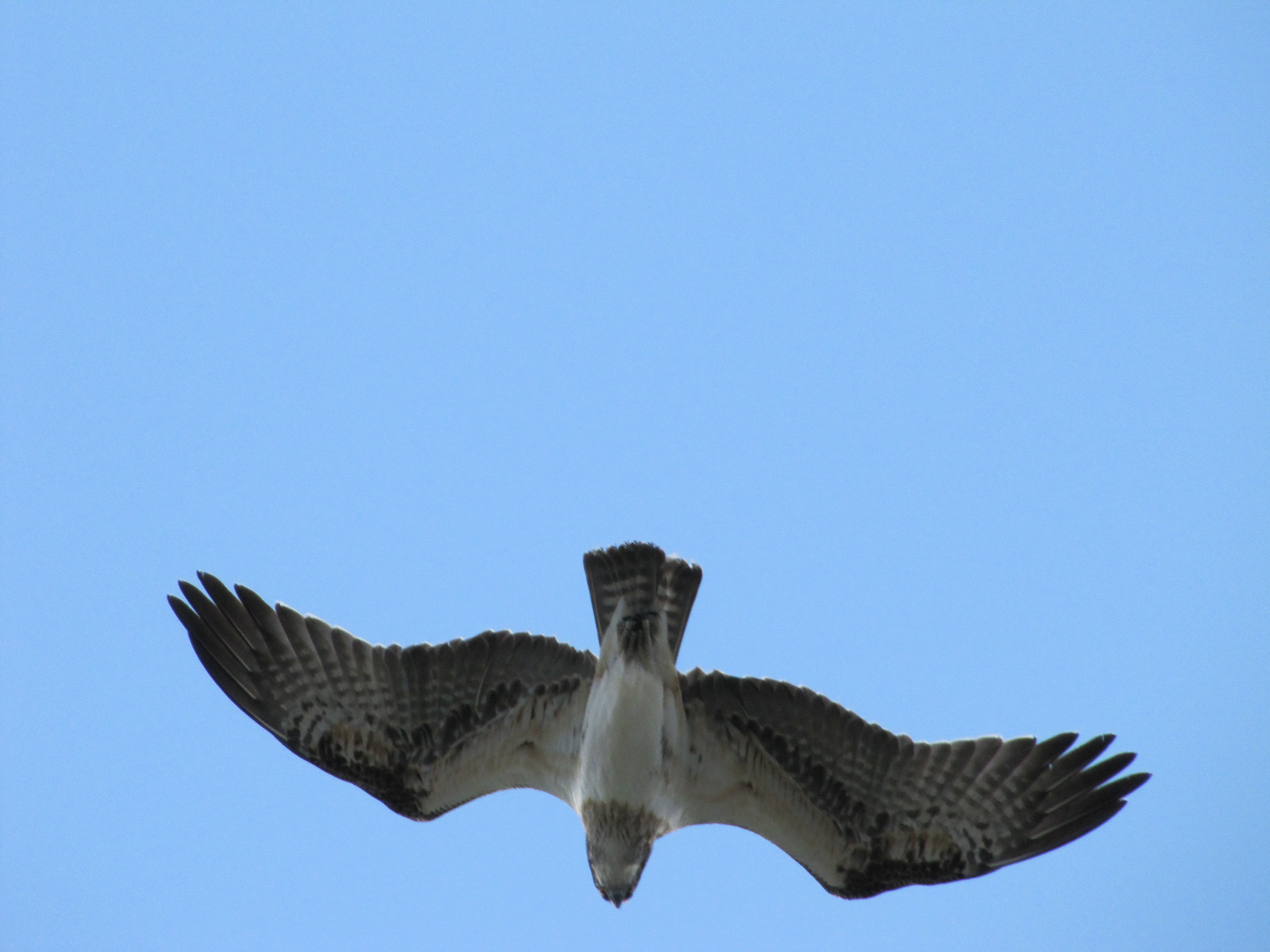
Because the link to the photo I wrote about no longer works, I’ve included one I took some time ago while on a holiday on the Yorke Peninsula in South Australia. It’s not a great photo but it shows the Osprey in flight.

Osprey

Osprey

Whose egg is that?

Quite often I find eggs lying on the ground in our garden. On more than one occasion I’ve wondered “Whose egg is this?” Last week I had such a request from a reader of this blog. Diana said:

I was just wondering if you could help me out, I’ve found a pure white egg, it was still warm and I couldn’t see a nest around. It’s only about as big as my thumb, what do you think it is? What should I do? Do you think it will hatch and if it does how will I care for it?

My reply unfortunately was less than helpful.

I am sorry but from your description it is almost impossible to tell what species of bird the egg belongs to. Where in Australia was the egg found? Where in relationship to trees, shrubs or buildings? What birds were around at the time? What are the common birds in your area?

There are so many variables that I couldn’t even begin to have a good guess. Eggs are often found on the ground and this is the result of a variety of events. We have some very active cuckoos in Australia which lay their eggs in the nests of other species. The baby cuckoos instinctively push other species eggs out of the nest before they hatch so that they get all the food. (Greedy, heh).

Other species steal eggs from nests to eat – crows, ravens, magpies, currawongs and many others. This is so that they may survive – it is the natural order of things, not cruelty. Sometimes these birds drop the eggs while carrying them.

Some species – especially pigeons and doves – make nests that are so flimsy that the egg simply falls through the bottom. The nests are so insignificant you might not even see them in a tree.

You are best advised to throw out the egg. Hatching it is a specialty job for the birds – or people who keep birds who have special incubators. Even if you did manage to hatch it, feeding the baby is far more demanding than a human baby – and we know how demanding they can be.

When you say it was as big as your thumb – did you mean you thumb nail? If so, it is possible it was a honeyeater’s egg – but which species is very hard to tell.

Sorry that I cannot give you any more help than that.

I know that this must have been frustrating for the reader, but it is really hard especially doing it at a distance via email – even with a photo. Goodness – it is even hard when one has the egg in hand.

We’ve come a long way – 800th post on this blog

New Holland Honeyeater

New Holland Honeyeater

Only a few weeks ago this blog saw its 3rd Birthday.

Today we celebrate another milestone – 800 articles about birds. Wow – it has been an exciting ride.

This blog has survived where many have fallen by the wayside or lie dormant and unloved.

The longevity of this blog is mainly due to all of my readers and those who frequently comment on what I have written. There are now over 500 visitors every day so a great big THANK YOU to all who have stopped by – especially those who keep on returning. So many of you have left great comments and the discussions have been stimulating. Often I am sent scurrying for my reference books to find the answers to your questions. Keep ’em coming folks.

Three Invitations:

  • You are all invited to leave appropriate comments and questions in the comments section underneath each article. Remember – comments are moderated – so keep it polite.
  • Alternatively, you can email me privately using the contact form here.
  • I also invite you to dig deeper into all those articles on this blog. If you have recently discovered this blog, I have 800 articles about Australian birds waiting to be read. You can access then in two ways: click on the archives link here or click on any of the categories or contents pages on the side bar.
Musk Lorikeet

Musk Lorikeet

Photo gallery:

Don’t forget the family photo gallery here.  Over 2000 photos from all over the world taken by members of my family. Not only bird photos – plenty of scenery, animals, flowers, historic places – well – just go and have a look. We are adding to it regularly too, so you are invited to return often.