Bird Words: bird watcher, birder, birding

Today’s word is not just one word, but three words. This is because they are all very similar.

  • Bird watcher: a birder, someone who watches birds as a hobby.
  • Birder: a bird watcher, a person who enjoys watching and studying birds.
  • Birding: the hobby of watching and studying birds
Typical Pose of Husband

Typical Pose of Husband

This is a photo of a dedicated birder in action.

I didn’t realise at the time that my wife had taken this shot of me.

For more in this series of articles check out the Glossary of Bird Words here.

Great Birding Moments # 19 King Parrot

I remember the first time I ever saw a King Parrot. It was back in the late 1970s on a holiday in NSW. We’d been several days in Sydney and we drove to Katoomba in the Blue Mountains. We were planning to take the children on the Scenic Railway which happens to be the world’s steepest incline railway and then cross the valley in the scenic skyway which takes you towards the famous landmark, the amazing rock formation called The Three Sisters.

We did all of those things and it was one of the highlights of our holiday. Unfortunately, we did not have a great view of the valley, the surrounding mountains or the Three Sisters due to thick fog for most of the morning. One thing did stand out in the fog, however. For the first time I saw an Australian King Parrot. As you can see from the photo the male is bright red and green. Viewing this species for the first time, from a few metres away, when everything around you is dull, foggy and damp is an amazing memory I have.

King Parrot at Adelaide Zoo

King Parrot at Adelaide Zoo

Related articles:

Cape Barren Geese

Cape Barren Geese

Cape Barren Geese

On Thursday we travelled south from Murray Bridge to the shores of Lake Alexandrina. The River Murray flows into this lake near Wellington before flowing out to sea near Goolwa. Just west of Wellington is a reliable spot to see Cape Barren Geese. They congregate in their hundreds here to feed on the local irrigated pastures.

Cape Barren Geese breed on the islands in Bass Strait between Victoria and Tasmania and also on the islands of South Australia and Western Australia. During the summer months they disperse to suitable grazing areas on the nearby mainland in South Australia, Victoria and Tasmania. In total there might be less than ten thousand birds, though some might dispute this figure.

On previous occasions I have counted over 500 birds in the one paddock where the above photo was taken making this locality a significant feeding ground for this species. Smaller flocks occur around the perimeter of Lakes Albert and Alexandrina, often in association with White Faced Herons, White and Straw Necked Ibis, Masked Lapwings, Australian Shelducks and the occasional flock of domestic geese.

Cape Barren Goose

Cape Barren Goose

Great Birding Moments # 18 Golden Headed Cisticola

Golden Headed Cisticola

Golden Headed Cisticola

Last Thursday we visited the Tolderol Game Reserve near Langhorne Creek, South Australia. It had been quite a time since my last visit and I was anticipating plenty of ducks, waders and other water birds to be present.

A Disappointing Day
It was a disappointing day. All the ponds were dry due mainly to the severe drought we are experiencing at present. It has been the driest winter, spring and October on record in this part of the state. The channels between the ponds contained some water but overall the birding was very disappointing. There were a few Black Swans, Whiskered Terns, Swamp Harriers, Masked Lapwings and White Fronted Chats. I saw a solitary Caspian Tern, several Little Black and Little Pied Cormorants and no Silver Gulls. Several White Ibis flew overhead as did a small flock of Straw Necked Ibis. A group of three Purple Swamphens skulked near one of the channels.

Feeling Despondent
As we were leaving I was feeling rather despondent. So few birds and nothing really special. I was wrong. A male Golden Headed Cisticola in breeding plumage emerged from the low scrubby bushes next to the rough track our vehicle was travelling on. He proceeded to sit out in the open and sing at volume, perched in a variety of poses for a good two to three minutes while I took a series of photos.

Range of the Golden Headed Cisticola
The Golden Headed Cisticola is not a species I have seen very often so this was an extra delight. The species is found throughout India, Nepal, SE Asia, Indonesia, Philippines and China. In Australia it is found in the northern, eastern and south eastern parts of the land, usually no more than 300km from the coast and only where suitable habitat exists.

Preferred Habitat

The Golden Headed Cisticola inhabits areas of tall grass, rushes, shrubby areas near wetlands, drains, sewage plants, irrigated paddocks and river flats. The Tolderol Game Reserve is part of the Lake Alexandrina and Lake Albert regions near the mouth of the Murray River. This area is probably its stronghold in this part of the state.

So the birding overall may not have been great, but the day ended on a happy note.

Golden Headed Cisticola

Golden Headed Cisticola

Time for a bath: visitors to our bird bath

Brown-headed Honeyeater

Brown-headed Honeyeater

Some years ago we set up a birdbath on our patio area. It gave us much pleasure to see birds coming to drink and bathe. More recently we moved it to the other side of the house. Now it is in full view from our sunroom. It is here we often eat our meals, and work at the table with the birdbath in full view.

Over recent years, this location has had four main benefits:

  1. It is a great time waster investment; watching the birds go about their daily lives just a few metres from where we are sitting is both relaxing and refreshing to the body, mind and spirit.
  2. It is most entertaining, especially when a bird like a Mallee Ringneck Parrot comes to bathe and the water sprays in all directions.
  3. It is excellent for photography; with the 12X zoom on my camera, I have taken many close-up shots of the birds visiting. (Update: my new camera has a 20x zoom. Further update: I now have a camera with an 83x zoom.)
  4. It is educational; our human visitors marvel at our avian visitors and this gives us the opportunity to further enhance our friends’ appreciation of the natural environment.
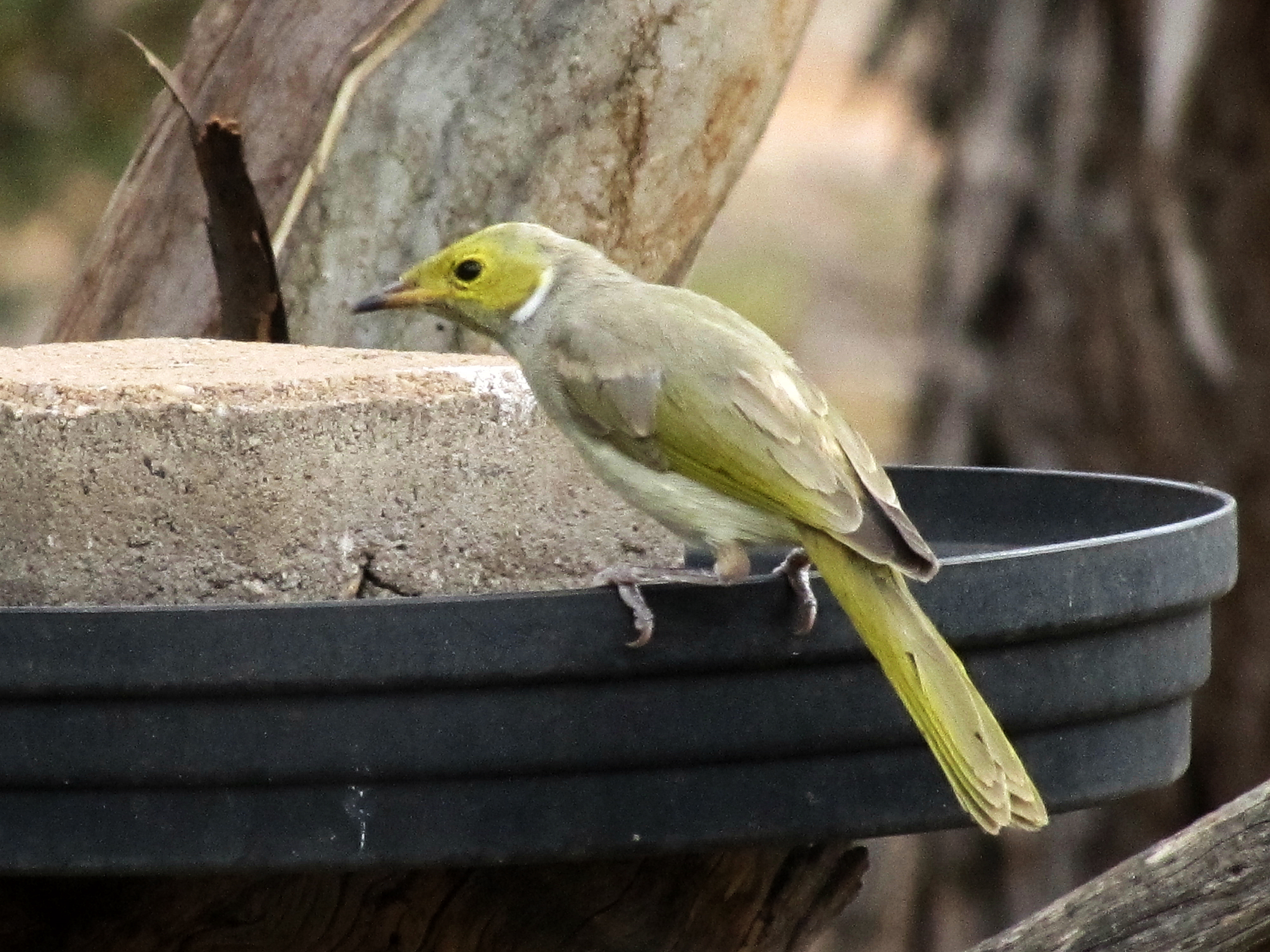
White-plumed Honeyeater

White-plumed Honeyeater

I’ve actually installed three different baths in close proximity to one another; one on the ground (which the lizards sometimes use too), one at a height of about 60cm and the third at about 1.5m. This gives them choices. The nearby branches and bushes give them a place of refuge if they feel threatened in any way.

House Sparrow (male)

House Sparrow (male)

A List of Species that have visited our bird baths:

  • Mallee Ringneck Parrot
  • New Holland Honeyeater
  • Spiny-cheeked Honeyeater
  • Red Wattlebird
  • Brown-headed Honeyeater
  • Singing Honeyeater
  • White-plumed Honeyeater
  • House Sparrow
  • Common Starling
  • Little Raven
  • Willie Wagtail
  • Spotted Turtledove
  • Crested Pigeon
  • Spotted Pardalote
  • Striated Pardalote
  • Diamond Firetail Finch
  • Yellow-rumped Thornbill
  • Grey Shrike-thrush
  • Australian Magpie
  • Magpie Lark
  • Mistletoebird
  • Common Blackbird
  • Rufous Whistler (see updates below)
  • European Goldfinch (see updates below)
  • Chestnut-rumped Thornbill (see updates below)
  • Grey Fantail (see updates below)
  • Black-faced Cuckoo-shrike (see updates below)
  • Galah (see updates below)
  • Grey Currawong (see updates below)
  • Eastern Rosella (see updates below)
  • Sacred Kingfisher (see updates below)
  • Dusky Woodswallow (see updates below)
  • White-browed Babblers (see updates below)
  • White-winged Chough (see updates below)
  • White-browed Woodswallow (see updates below)
  • Purple-crowned Lorikeet (see updates below)
  • Animals
  • Red Fox
  • Stumpy-tailed Lizard
  • European Rabbit
  • Brown Snake
  • Blue-tongue Lizard

That’s quite a list!

UPDATE: More recently we have added the following species to the list:

  • Rufous Whistler
  • European Goldfinch
  • Chestnut-rumped Thornbill

UPDATE #2 Two more species to add to the list:

  • Stumpy-tail Lizard (also called a Shingleback Lizard)
  • Red Fox – yes, that’s right, a fox.
  • Brown Snake – passed close to the bird bath on the ground. In January 2016 a metre long Brown Snake actually stopped to have a drink. See photos here.

UPDATE #3 Another species to add to the list: Grey Fantail – it came to the bird bath briefly but left before I could take a photograph (4th May, 2007)

UPDATE #4 In January 2008 we had a single Black-faced Cuckoo-shrike come to drink briefly from the bird bath.

UPDATE #5 In late January 2008 a single Galah came to within a metre of the bird bath but did not drink. A few weeks later I added Grey Currawong to the list.

UPDATE #6 In December 2008 I added European Rabbit to the list.

UPDATE #7 In December 2009 I added Eastern Rosella. (Click here for a photo)

UPDATE #8 In November 2013 a Sacred Kingfisher perched about a metre from the bird bath but did not drink. In February 2014 a Dusky Woodswallow came to drink during one of our heat waves during a very hot summer.

UPDATE #9  In September 2015 I added White-winged Chough, White-browed Babbler and Blue-tongue Lizard (click for photo)

UPDATE #10 In December 2015, during a heatwave, I added White-browed Woodswallow.

UPDATE #11 In December 2020 I added Purple-crowned Lorikeet.

Comments: many of my readers have commented on this post – read them below and leave one of your own.

Update: this post was last updated on December 2020.

Mallee Ringneck Parrot

Mallee Ringneck Parrot

Mallee Ringneck Parrot

Mallee Ringneck Parrot

Mallee Ringneck Parrot

Mallee Ringneck Parrot