Short stay in Victor Harbor

Granite Island, Victor Harbor

Granite Island, Victor Harbor

Caravan Holiday
This afternoon we hitched up the old caravan and journeyed down to Victor Harbor on the coast south of Adelaide, South Australia. This trip has become an annual trip for us. We had sites near six other couples who stayed in the same caravan park. During the weekend our wives attend the CWCI Convention. All the men sit around in the shade of the trees in the park and attempt to solve the world’s problems – usually unsuccessfully.

Birds of the Caravan Park

We arrived at about 4:30pm and after checking in we set up the caravan. From our site we had an excellent view of Encounter Bay and Granite Island just off the coast. The beach is about a hundred metres from our van, with no buildings or other things obstructing our view. Throughout the park there are numerous birds, many of them very tame.

Australian Magpie (White-backed race)

Australian Magpie (White-backed race)

Australian Magpie

The most obvious resident of the park is the Australian Magpie. I didn’t do a count of actual numbers but they are present throughout the park. They are very tame and will come to within a metre or so if one is sitting outside the van. This provides many photo opportunities and I was able to get several good shots. They keep a careful watch if one is eating outside, expecting a free handout. When there is nothing on offer they skulk around looking for any unwary creatures lurking in the grass. The spear like thrust of the beak often rewards them with a tasty morsel.

Rainbow Lorikeet

Another common park resident is the Rainbow Lorikeet. The park has many eucalyptus trees, some of which were heavy in flower. This accounts for the many lorikeets and the constant screeching calls. They will feed for a while before wheeling off through the park in twos and threes, screeching as the go to another tree.

Other Bird Species

Because there were many flowering trees in the caravan park there were also quite a few honeyeaters scattered everywhere. New Holland Honeyeaters, Red Wattlebirds, Little Wattlebirds and Noisy Miners were the common honeyeaters I observed. There were also some White Plumed Honeyeaters but they were not calling as much as they are sometimes inclined to do.

Masked Lapwings

This evening as we arrived home from a meeting we heard two Masked Lapwings flying over head. It was a still, bright moonlit evening and their calls carried far. At one point one of the birds flew directly above me but I was unable to see it, despite the bright moon light.

Masked Lapwings are a common species around our home town of Murray Bridge. They are often seen near water or lawned areas, such as ovals and parks. From time to time we hear them nearby, or flying over head. Sometimes we even get to see them, but I have never actually seen them on the ground on our two hectare (5 acre) property. The nearest oval is some 500 metres away so they must have been disturbed from there, and then flew over our house.

For more information about Masked Lapwings, including a photo, click here.

Birds in Adelaide Parklands

Rainbow Lorikeets

Rainbow Lorikeets

Writers’ Week

Today I attended the Thursday sessions of Writers’ Week in Adelaide. This is a regular feature of the Adelaide Festival of Arts which is held every two years. Prominent writers from all over Australia and selected writers from overseas are invited to be guest speakers. Previously I have been unable to attend because of work commitments.

Adelaide Parklands

Writers’ week is held in a beautiful section of Adelaide’s parklands, about 200 metres across the road from the Festival Centre and about five minute’s walk from the CBD. While I primarily attended to hear the speakers talking about their writing and books, birders like me are naturally always on the lookout for birds flying around. As the tents where the sessions are held are open sided, the birds are easy to observe.

Noisy Miner

Noisy Miner

Bird List

The most conspicuous species was the Rock Dove. Groups of three to five flew overhead or around the nearby buildings every minute or so. The next common species was the Rainbow Lorikeet. Small flocks of up to six or eight went screeching from tree to tree at least every five minutes. Noisy Miners squabbled and carried on in nearby trees all day. I was surprised none came down to the lawn to search for dropped food. Perhaps the large crowd was too intimidating even for them. I also observed two Sulphur-Crested Cockatoos over the Torrens River, several Adelaide Rosellas (a sub-species of the Crimson Rosella) flying nearby and a single Magpie Lark. Surprisingly, I also saw only one Crested Pigeon all day. They are a very common species in the parklands.

Crested Pigeons

Crested Pigeons

Unexpected Sighting

The most unexpected sighting was a Brush-Tailed Possum. It came scampering across the grass from the back of the Governor’s residence, through the chairs of about a dozen attendees, and disappeared up one of the beautiful palm trees in that part of the garden. These mammals are essentially nocturnal, so that makes the sighting even more interesting.

Related Articles:

Sulphur Crested Cockatoos

Sulphur Crested Cockatoos

Rainbow Lorikeets


Above: Photo of a Rainbow Lorikeet

Rainbow Lorikeets would have to be one of Australia’s most beautiful birds. They are aptly named. As they fly overhead in a flash of colour they light up their little patch of the azure blue sky. Their feathers are a brilliant blend of bright reds, greens, blues and yellows. As they screech overhead – and that is an accurate description of their harsh calls – their stunningly red underwings are like a blood-streak across a blue backdrop.

Rainbow Lorikeets are widespread along the northern, eastern and southern coastal regions of Australia. Their preferred habitats include woodlands, rainforests and wherever eucalyptus trees are numerous. They are easily seen in parks and gardens throughout many of our towns and cities.

Despite being quite common I have had some difficulty getting reasonably clear photographs of this species. When flying they seem to be going too fast to focus on them. When feeding they are often well hidden in the thick foliage of a eucalypt tree as they search out nectar from the flowers.

A single tree, if heavily in flower, can be host to twenty or thirty of these stunning beauties, their contact calls a never-ending chorus of murmurings and chattering. Yet, despite the numbers, most remain hidden amongst the leaves, usually near the top and out of sight – but not out of earshot. In large numbers their screeching can be deafening, especially near sunset as they squabble and jostle for roosting spots.

Update:

Since writing this article I have managed to take several good shots of this beautiful bird, so I ‘ve added one of them below. Click on the image to enlarge it.

Update:

This article was further updated in July 2015.

Rainbow Lorikeet, Royal Botanic Gardens, Sydney

Rainbow Lorikeet, Royal Botanic Gardens, Sydney

Rock Doves

This posting sits a little uneasily. All postings are supposed to be about Australian birds. I am about to break my own rule and show some photos of an introduced species, the Rock Dove or Feral Pigeon. (It is also called a Domestic Pigeon or Homing Pigeon).


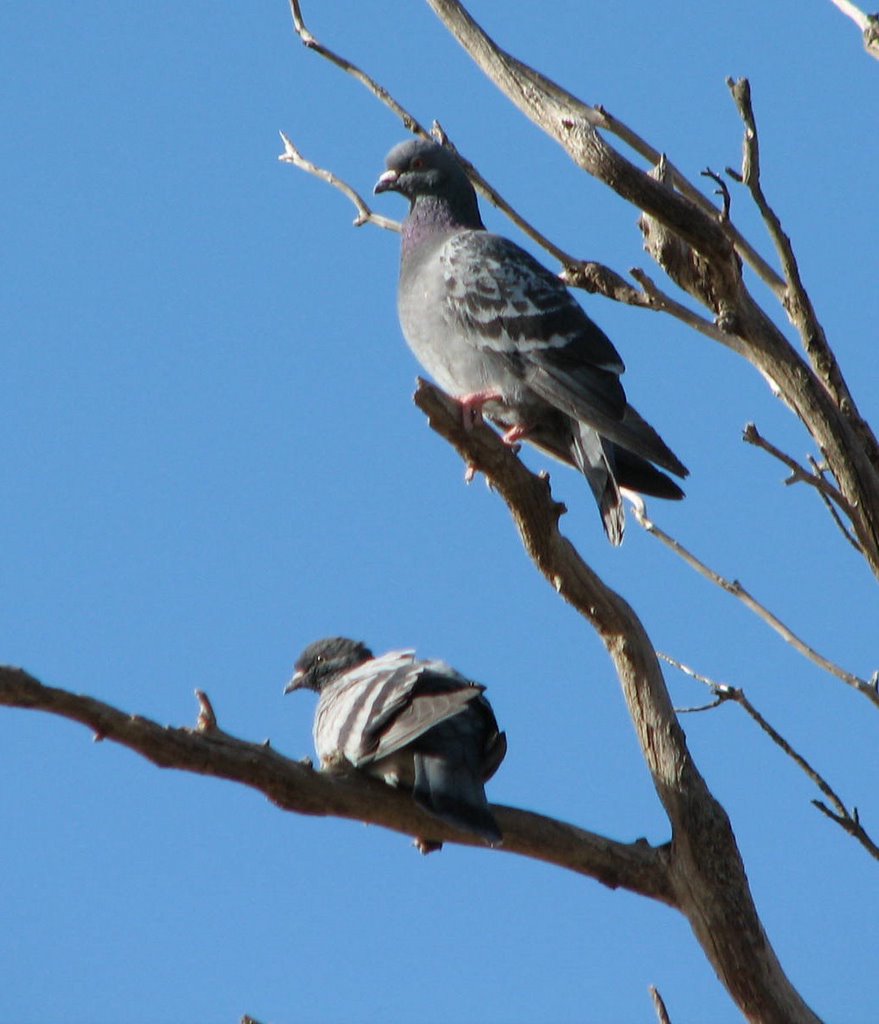
Above: Photo of Rock Doves perching on a dead
eucalyptus branch, near Murray Bridge, South Australia.

A few weeks ago I managed to get a good photo of two Rock Doves perched on the dead branches of a eucalyptus tree near our home. They allowed me to approach quite close before flying off. Many more were feeding on the ground in a nearby paddock.

In Australia, like so many places, they have become a pest species, especially in city parks and gardens. I have also seen large flocks numbering in the thousands along the coastal cliffs in parts of South Australia.

Rock Doves were introduced to Australia many years ago and have successfully spread throughout the more temperate regions of southern and eastern Australia. They have been particularly successful in our larger cities and towns. Very large flocks can also been seen near grain storage silos in rural areas.

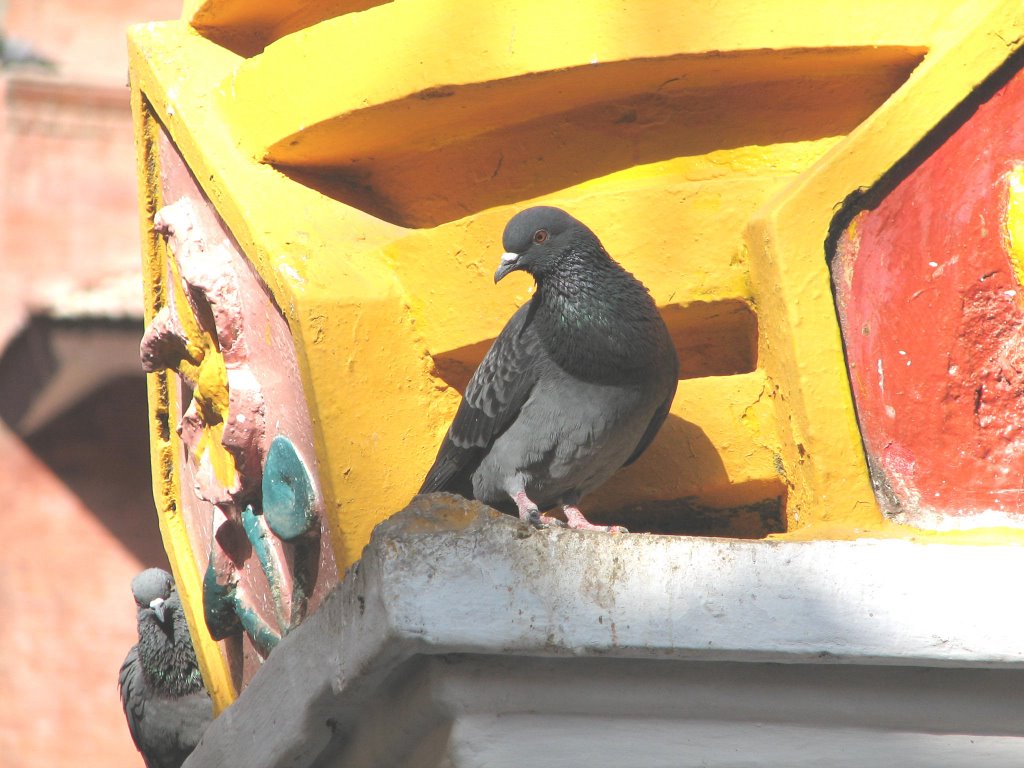
Many cities around the world have a massive pigeon problem. The health risk posed by these birds must be enormous, not to mention the mess they make. On a recent visit to Kathmandu, Nepal, I had the misfortune to be the target of not one but two pigeons on the same day. This annoyance resulted in some extra washing in my hotel room that night. I was so pleased I was wearing a hat at the time.

Above: A photo of a Rock Dove on a temple, Kathmandu, Nepal.
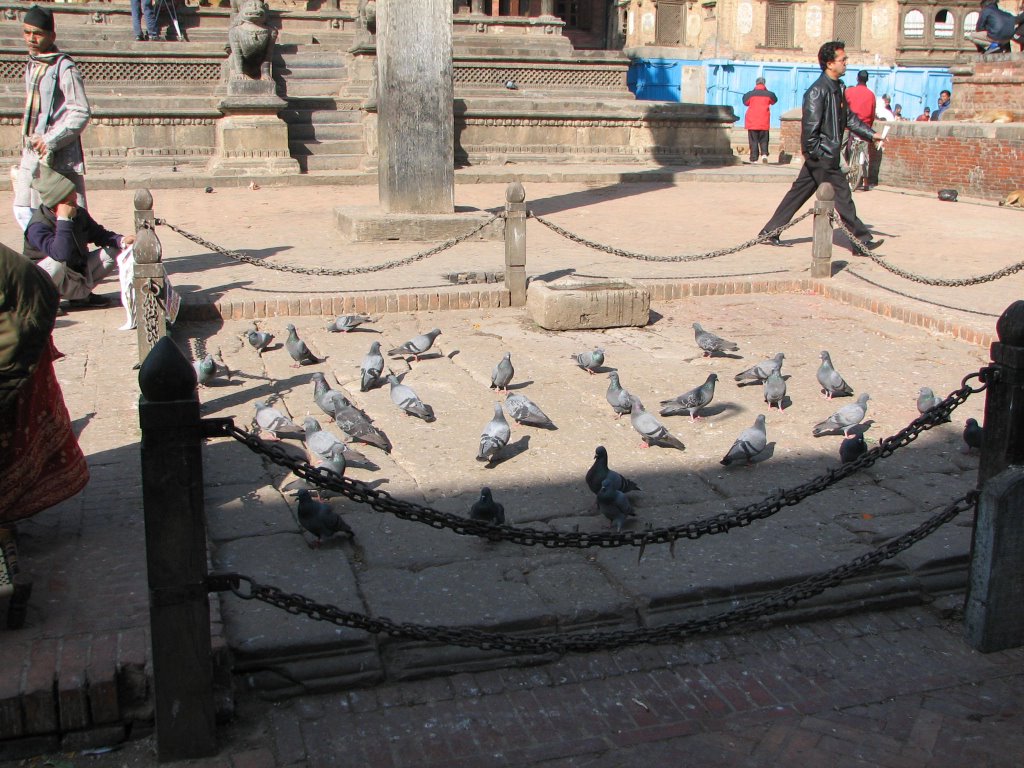
Several days later while visiting the city of Patan, Kathmandu, I saw a local lady selling food for tourists and locals to feed to the local population of pigeons. As the seed was spread by her customers, hundreds of pigeons descended from the nearby temples and other buildings in thick clouds of flapping feathers. They all assembled hurriedly in a little chained off area set aside for the purpose. This is not the way to discourage their booming populations. I didn’t stop to ask if feeding the pigeons had some religious significance; perhaps it did.


Above: a photo of pigeons in Patan, Nepal.