How sweet it is

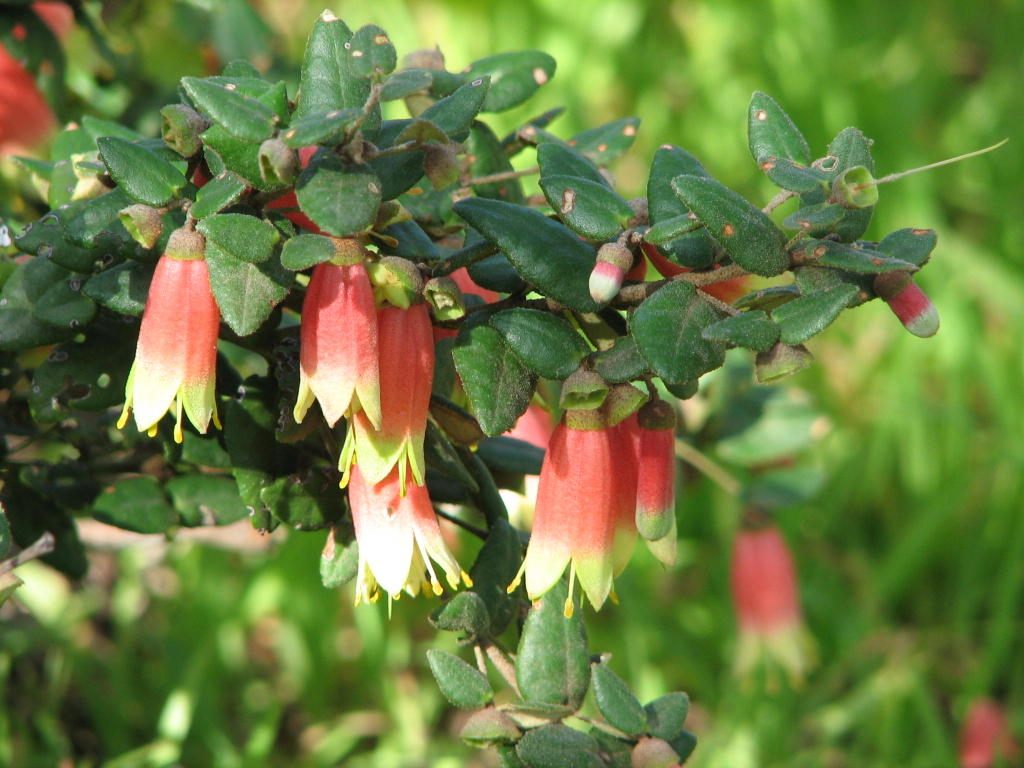
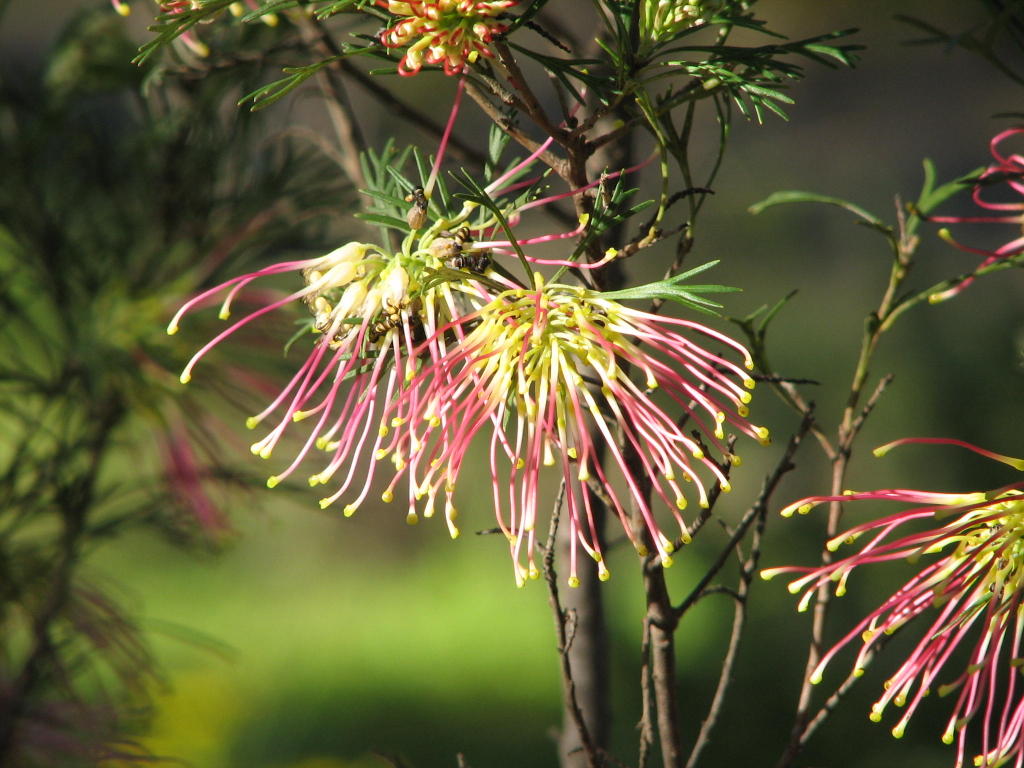
I have been trying for several days to capture a New Holland Honeyeater doing their usual gymnastic tricks while feeding. Just before lunch today I managed to get one upside down feeding from a flower in an Eremophila youngii. Eremophilas are commonly called Emu Bushes.


No – I haven’t inserted the photograph upside down! It’s the bird that is upside down. The curved beaks of the Ausralian honeyeaters are ideally suited to feeding from many of the Australian plants like the Eremophilas, Correas and Prostantheras with their tube shaped flowers.Of course the New Holland Honeyeaters don’t have it all to themselves. The Red Wattlebirds also insist on their fair share of the spoils. The above photo shows a Red Wattlebird busy in another eremophila nearby. A few seconds after this photo was taken a New Holland Honeyeater tried to chase the wattlebird away, only to have the tables turned and become the one being chased.
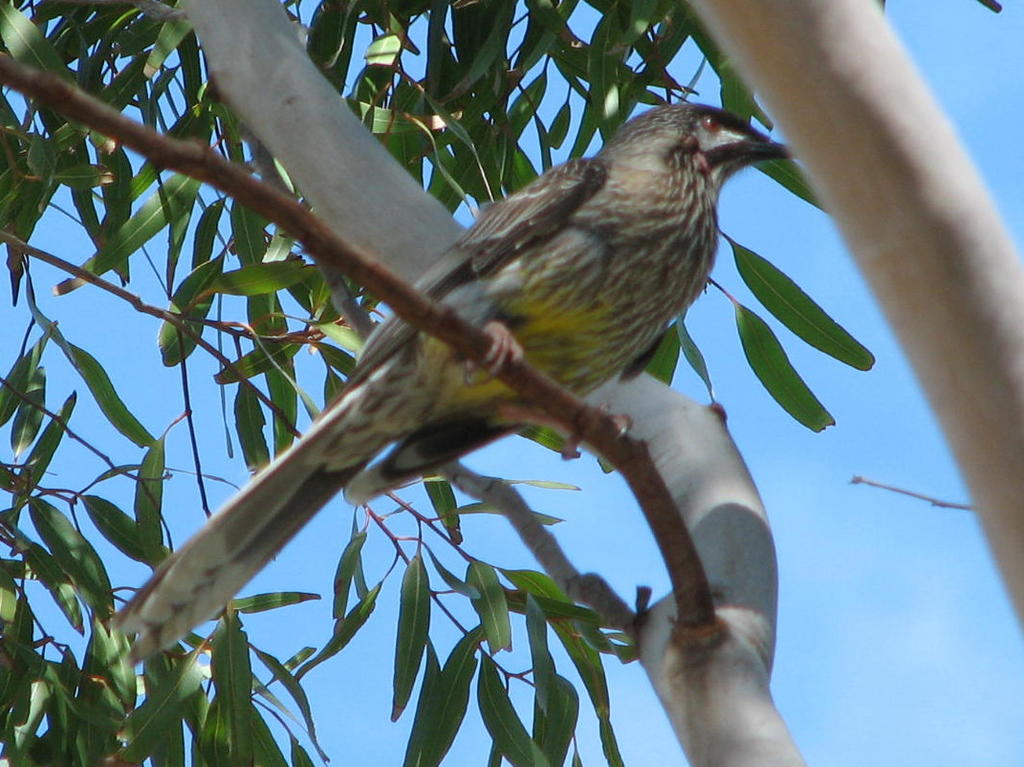
Wattlebirds can be bossy creatures, especially if another bird tries to muscle in on their patch of food. The above photo shows a rare moment in the life of a Red Wattlebird – sitting peacefully on a branch of a Eucalyptus citriodora or Lemon Scented Gum. On closer inspection of the photo I just realised that this individual is keeping the above eremophila plant under surveillance.
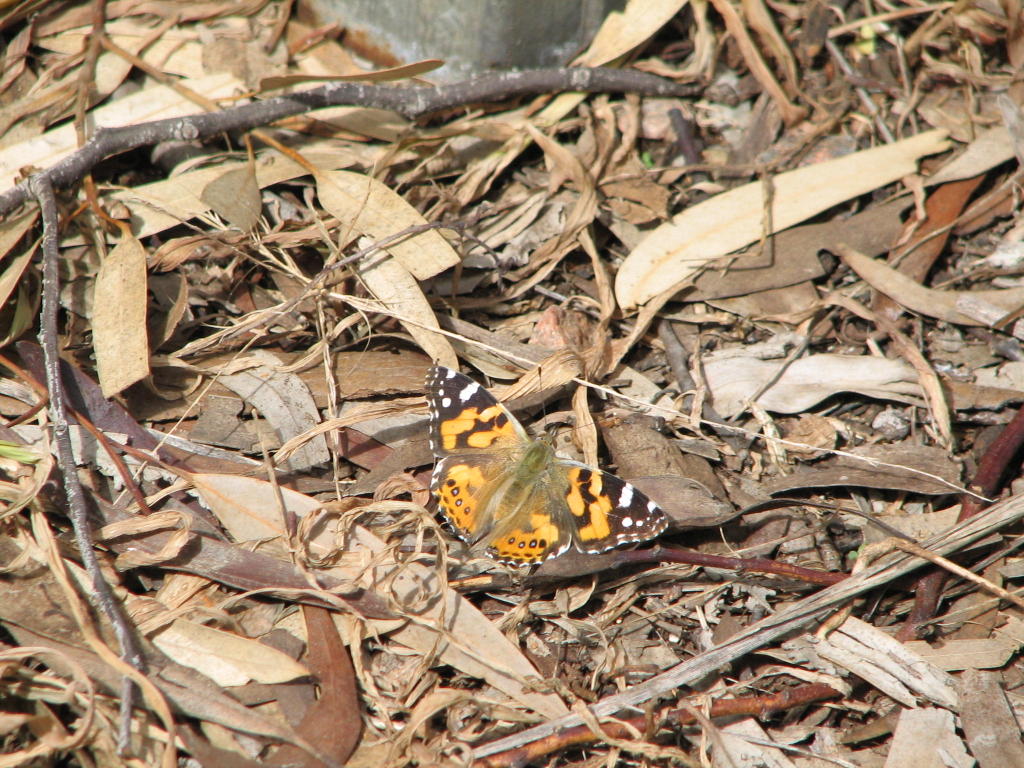
My new interest in butterflies continues unabated. I didn’t realise how many butterflies we have around our garden until I started quietly stalking them, camera poised. Today I managed several reasonable shots of the Vanessa kershawi or the Australian Painted Lady butterfly. We have at least two other species common in our garden, but I have yet to get a good shot of them. I know of at least two other species that have visited in the past but I haven’t seen them for several years.

Here’s another challenge I could set myself. Try to get some photos of the dragonflies we have around here! Then I could move on to other insects, such as ants and beetles. And what about caterpillars? Oh, and then we have quite a selection of reptiles, including Brown Snakes (which are very dangerous so I don’t want to get too close; the zoom lens will help there).

As for lizards, they are on the move already. I have included a photo taken yesterday of a Stumpy-Tailed Lizard (also called a Shingleback). We have quite a few individuals on our little estate. I haven’t seen any young Stumpy-Tails for a few months. We did see several in the autumn months. We enjoy seeing them come to one of the bird baths for a drink. The Aussie expression “flat out like a lizard drinking” is so apt. To illustrate how common this species is in the Murray Bridge area, our local poetry competition is called “The Stumpies”. I’ll try to get a link to details of this award.

We also have a range of geckoes and skinks on our land, all of them quite beautifully marked and would make wonderful photographs to include in this journal. Then we have the following mammals present (or occasional visitors): Western Grey Kangaroo, Common Brushtail Possum, Short-Beaked Echidna, Brown Hare*, European Rabbit*, House Mouse*, Black Rat*, Red Fox* and feral cat*(*introduced). I am sure we probably also have four or five species of bats but I’ve only indentified the Western Broad-Nosed Bat.

Mmmm… methinks I’ve opened a can of worms here!

Worms???
How photogenic are worms??

PS. I’m so pleased I do not have to buy film for this new camera.
Hi there honey – encounters with honeyeaters

We are not short of honeyeaters in Murray Bridge. They are common everywhere in this district and are probably the most common bird in most people’s gardens. Other species may outnumber them along the river or in the farming areas. For example, Straw-Necked Ibis numbers along the dairying flats are very numerous. I have seen flocks of over 400 on many occasions. Flocks of Galahs of that size are also evident, especially where wheat is cultivated. Along the parks and trees lining the River Murray large flocks of Little Corella can also be seen on occasions.

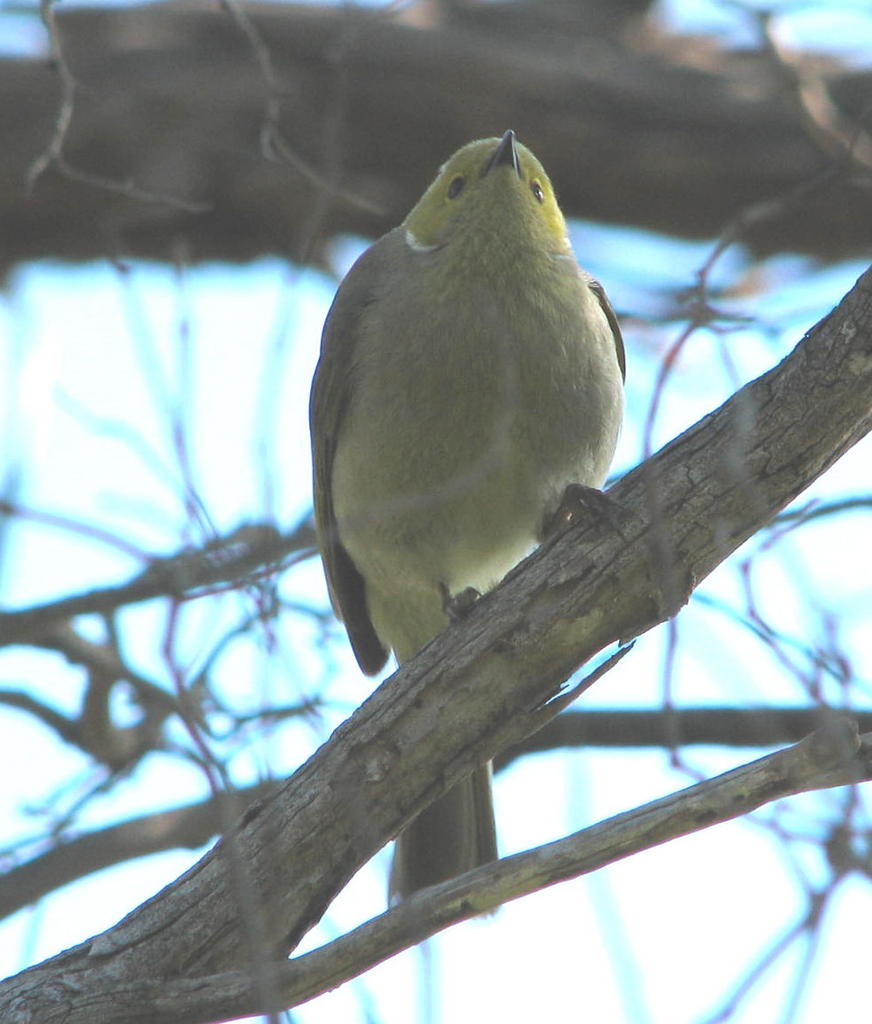
In the gardens, however, the honeyeater species tend to dominate. We do have some Noisy Miners in the area but they are not (yet) the dominent species they seem to be in other parts of Australia. In the Murray Bridge district New Holland Honeyeaters probably outnumber all other species of honeyeater. Red Wattlebirds are also very common as are White-Plumed Honeyeaters.

Last Monday we went to visit my wife’s mother. She lives in a retirement village, Murraylands. Part of the complex opposite her unit is a plantation of native Australian plants, established 20 years ago and maintained by the local members of the Australian Plant Society. The local group is in recess due to lack of members, Corinne (my wife) is the immediate past-president and I am also a past-president.

While Corinne was collecting cuttings for propogation I was taking photographs of various flowers for her. (I have included several photos at the end of this posting.) There were many birds in the locality, including a number of White Plumed Honeyeaters. Two of them came close to investigate what I was doing, so I took several photographs. I was basically shooting into the sun so the photos are not candidates for “Best of Show” in an exhibition. They turned out quite dark so I have enhanced them to show them here. I only include them here because of the unusual stance of the birds.

The first photo (above) shows one bird looking straight down at me. The eyes are what caught my attention. It’s a rather bizarre view of a bird. The second photo shows the other bird’s response to the focussing beep on my camera. It obviously heard the soft beep as I focussed. Pity about the lack of colour.

The native plant garden at Murraylands Homes is about an acre in size. It includes a wide range of Australian plants, including eucalypts, wattles, grevilleas, correas, eremophilas, callistemons and many others. Below I have included a selection of the shots I took.

Correa reflexa “Sellick’s Beach”

Grevillea “Winpara sunrise”

Alyogyne huegelli (Native hibiscus)

New Holland Honeyeaters

New Holland Honeyeaters are a common Australian bird, especially in parks and gardens. Good views of them can be easily had as they flit to and fro from bush to bush. Sometimes they even sit still enough for good views of their beautiful markings. On rare occasions they even sit long enough to capture a photograph!

This stunning photograph was taken a few days ago while looking over our neighbour’s fence. The bird posed long enough for me to take several shots. The green object it is perched on is the handle of a small hand operated plough. Our neighbour has several old farm implements in his front garden.

New Holland Honeyeater

Over the years I have been interested in the occurrence of New Holland Honeyeaters in our garden. They are probably the most numerous and widespread species of honeyeater in the Murray Bridge region. In the first 15 years of us living here they were only occasional visitors to our garden and patch of mallee scrub. I have kept monthly records of all birds seen on our property since January 1985. My database of bird observations (BirdInfo – which is no longer available) shows a sudden increase of observations in late 1998. From that time to the present New Holland Honeyeaters have been the predominant honeyeater species here.

Other species of honeyeaters recorded here include:

Red Wattlebird: resident, breeding species.
White Plumed Honeyeater (resident, breeding)
Spiny Cheeked Honeyeater (resident, breeding)
Striped Honeyeater (occasional visitor, one breeding record)
White-Eared Honeyeater (occasional visitor)
Yellow Plumed Honeyeater (occasional visitor)
Singing Honeyeater (resident, breeding)
Brown-Headed Honeyeater (resident, breeding).

You can find photos of many of these honeyeater species, including photos, by searching on this site, or clicking on the species name (not all have links).

One possible explanation of this change is the maturing of many of the native Australian plants we have planted over the years. Our property is now far more bird welcoming than, say 15 years ago.

Callistemon flowers

Update: this post was updated on November 5th, 2013.

Everything is quite ducky

As I awoke this morning I was aware of quacking noises outside.

Now, although we live in Murray Bridge which is situated on the Murray River, Australia’s longest river, our property is a good five kilometres from the river.

The quacking persisted. Those ducks are here again, I thought. Pacific Black Ducks are common in this area and are not restricted to just the river itself. It is not usual to find them in parks and gardens. Two, sometimes three, are regular visitors to our own garden.

Pacific Black Duck

“Our” ducks have taken a liking to our in-ground swimming pool (affectionately known as “the swamp” – look at the photos and you will know why). Almost daily they visit for a swim or just to laze by the poolside. They don’t seem to mind how frosty it gets here in winter, poolside is the place to be.

Pacific Black Duck with ten ducklings


Last year they slipped a surprise under our radar. Before we knew it, we were the adopted “grandparents” of six ducklings. Sadly, their parents abandoned them. We quickly discovered that raising little ducklings is not a skill one acquires overnight. They were far too weak, cold, wet and hungry when we took over as substitute parents, and they all died, despite our best efforts.

Update: this post was updated on 5th November 2013 with better photos. The mother duck with ten ducklings was taken on another occasion.

My first Blog entry

I am a first time Blogger. This is my very first entry having successfully stepped through the setup process.

I am reasonably familiar with the world of blogging because I regularly read the blogs of my daughter Rose in England and son Simon in Sydney (when he’s home), mainly to keep up with what they are doing and where in the world they are!

I plan to include recent interesting sightings of birds in and around our garden and property on the fringe of the rural city of Murray Bridge in South Australia. Our home is situated on 5 acres (2 hectares) of land. We have about two acres of mallee scrub and have planted several thousand trees and small plants on the rest.

I will also include reports on any trips I take here in South Australia and in other parts of Australia – and overseas when that happens. I also plan to include photos of birds (and other interesting things) taken with my new digital camera, a Canon Powershot S2 IS. The 12x zoom facility is great for birds shots. (Update: I updated my camera in 2011 to a Canon Powershot SX20 with a 20x zoom. Photos from the latter part of 2011 were taken with the new camera.)

Crested Pigeon

It has been raining steadily here all morning so we are confined to the indoors. The bird life has been very quiet during the rain, but when I went to check the rain gauge a few minutes ago I observed five rather wet Crested Pigeons on a nearby power line. Sometimes I have observed up to 30 or 40 of these beautiful birds all perched on the power lines that run along the side of our property. Above is a photo of a Crested Pigeon taken yesterday. It was quietly sunning itself near the house. I was able to sneak up to within about 4 metres from it.

Mistletoebird


Yesterday I also managed to get a good photo of a male Mistletoe Bird. These delightful little birds are quite common around here and are frequent visitors to our garden. About 15 years ago this was the first species I recorded nesting in a plant we had planted on this property.

This post was updated on 2nd September 2015.

Good birding.

Trevor