Do Emus Swim?
I guess the Emu is one of the most recognisable birds in Australia. Not only is it our biggest bird, it also features on our coat of arms. Most Australians would instantly recognise an Emu if they saw one out in the wild or in a park. Birders from all over the world would probably have a fair idea of what an Emu looks like.
I hope my readers know what an Emu looks like because strangely enough I don’t seem to have taken one with my digital camera. (Somewhere on several thousand old slides I am sure I have several, but finding them would take all day). See update below.
A question arose recently on the Birding-Aus forum, “Do Emus swim?” The answer is most definitely “yes.” It is not a common activity but they can and do swim.
Some years ago we were on a boat cruise on the Lower Glenelg River near Nelson in south-western Victoria. This was a very relaxing two hour cruise on a lovely stretch of the river. The birding was also very good, with excellent views of Peregrine Falcons along the way. On our return voyage back down river, the captain suddenly interrupted his commentary to point out two Emus swimming across the river about fifty metres in front of the boat. Only their snake-like necks showed above the water. He slowed the boat and turned so everyone on board had a good view.
On reaching the shore, the emus shook their feathers vigorously before heading off into the bush. The captain explained that despite doing this cruise almost every day for over twenty years he had never seen Emus swimming. I later checked with other readers of Birding-Aus and some said that it was relatively common along the River Murray, especially in times of drought when the Emus are migrating, looking for food.
UPDATE:
I now have some photos of Emus to share with you. These were taken last year at our local Monarto Zoo – just a few kilometres from my home. I have also added some links to other articles about Emus.
UPDATE #2
Parts of the above article were quoted in an article in the Sunday Mail, a weekly paper published in South Australia. It appeared in the July 12th 2015 edition.
Related articles:


White Browed Babblers and water
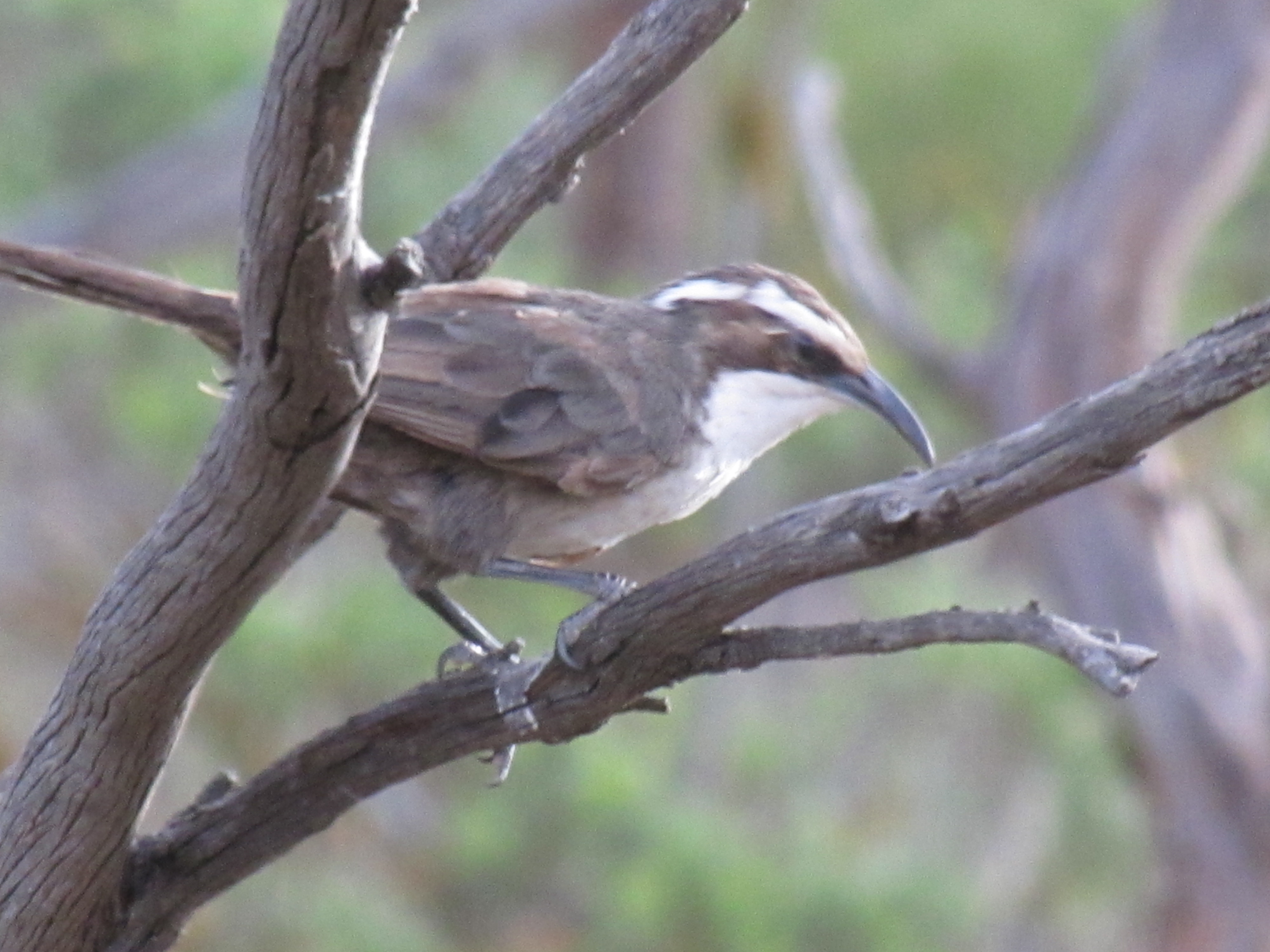
White-browed Babbler
I’ve written a number of times about the birds that come to visit the bird baths in our garden (see the links below).
We are constantly delighted to see the stream of honeyeaters, pardalotes, parrots and many other species that come to drink. Some linger awhile to bathe. Some are tentative in their approach, others come in boldly, chasing away any who may linger too long.
White-browed Babblers
White-browed Babblers are frequent visitors to our garden. They come in their family group, scuttling through the low bushes, scurrying up the branches of the mallee trees searching for insects and spiders and filling the air with their cat like calls.
From time to time their foraging antics bring them close to the bird bath. Sometimes they get as close as a metre away. I have never seen them land on the bird bath, let alone take a drink or bathe.
I recently read a series of posts on the Birding-Aus forum that many species of birds do not need to drink, or drink very infrequently. They manage to gather enough moisture from the insects, beetles and spiders they eat.
Related Articles:
- Birds in the heat – birds that visit during hot weather
- Birds and communal bathing – water wasters at work
- Time for a bath – a long list of birds and animals which come to our bird baths
Updated November 2013, and September 2015
Bird Words: fledge, fledgling
- Fledge: a bird is said to fledge when it is able to fly.
- Fledgling: a young bird that is partly or wholly covered in feathers. It is also used of a young bird when it first begins to fly.
Fledgling birds can be very easy to see because they are still learning to fly and will hang around more than more mature birds. However, they are sometimes not as easy to identify because their plumage has not fully developed the adult colours.

Willie Wagtail (baby)
One big plus for identification is the feeding habits of the parents. If you remain quiet and still a short distance away, the parents will often come up to feed the new fledgling bird, making your identification much easier.
Except in the case of young cuckoos; that’s a whole new ball game.

New Holland Honeyeater (baby just out of nest)
Now for some lighthearted fun
Birding can be fun.
Birding is often great fun.
Birding can be really entertaining.
Birding can be very lighthearted at times.
Click on the link below for a good laugh. It may take a few minutes to load in dialup. Be sure to have your sound turned on.
Cartoon: Birds On A Wire – hope you have a good laugh.
Birding Bloopers #10
No Comments »27th February, 2007; Category: Bird Behaviour, Birders, Birding bloopers, Ravens and Crows
Anthea is a regular contributor to the Birding-Aus forum. She has given me permission to quote her intriguing encounter with a Little Raven that had a very interesting taste for the unusual. And as with all the bloopers featured on my blog, Anthea thought the bird was eating something completely different.
I was on the beach at Point Lonsdale, some years ago, observing a Little Raven which appeared to be subduing prey. Heavy pecks were repeatedly directed at something on the sand, and I was pretty sure I could see a long thin tail thrashing about. It picked up the prey item and flew to a low branch. I hastily took a photo! More pecking and thrashing – was that a small black leg and foot, with claws, beside the tail ? Small mammal, say a mouse? I was quite excited by the time it dropped the item and flew off.
I hastened to investigate … It was part of a dried, black mummified banana peel divided into a number of longways strips – one narrow one was the tail, a truncated, ragged shorter part was the leg. What the Raven found to eat on it I really don’t know!
Thanks to Anthea for her contribution.
Read more birding bloopers here.
Question for readers:
When did you experience an embarrassing birding moment? Perhaps it was a mistaken identification. Perhaps you didn’t look carefully enough and were later proved wrong. Maybe the bird itself fooled you in some way.
I invite readers to submit their birding bloopers in the comments section below. If it’s good enough I might just feature it in a post of its own, with a link back to your blog (if you have one).