Aggressive Bird Behaviour in the Garden
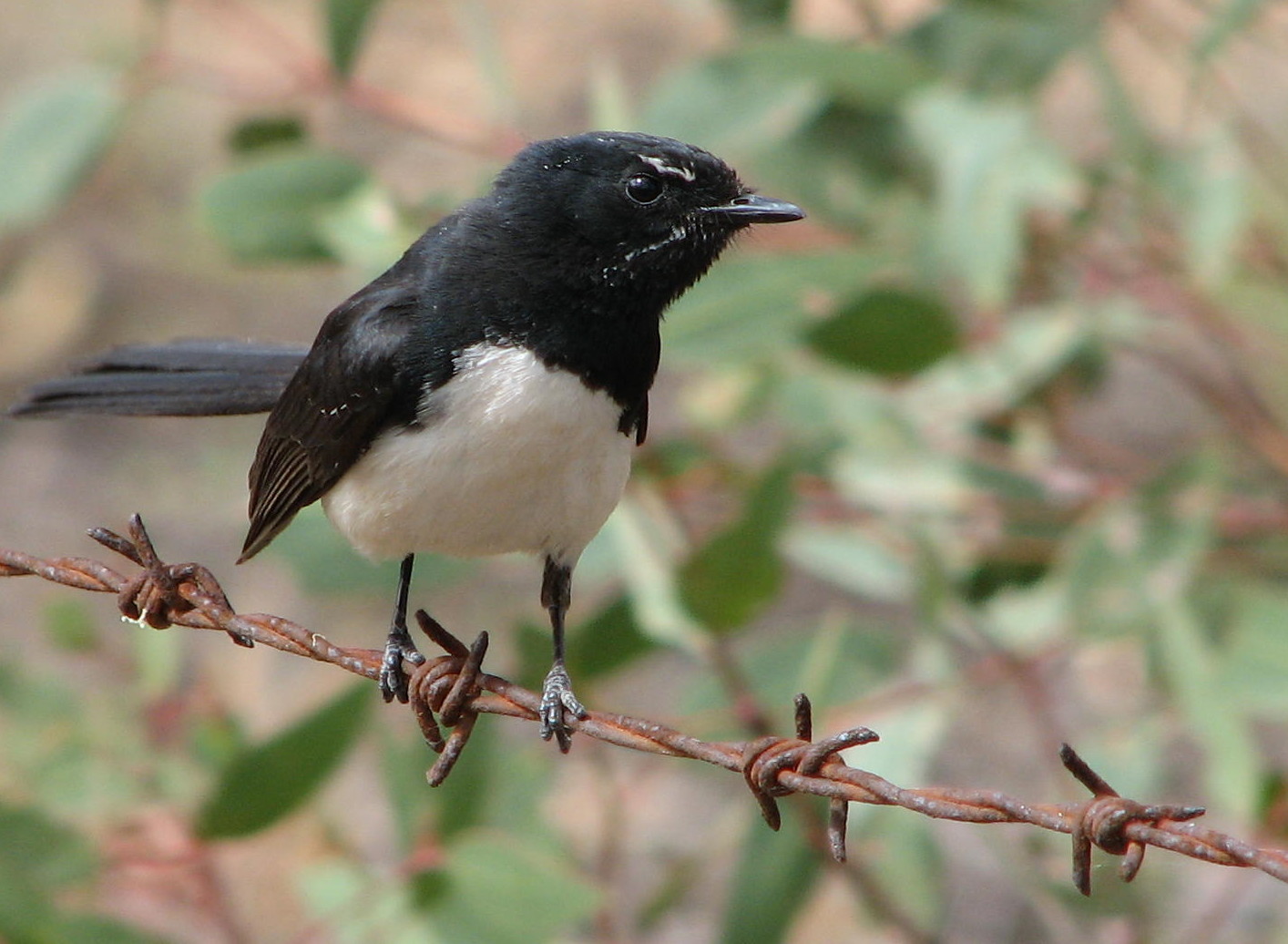
Willie Wagtail
While working in the garden yesterday morning I was suddenly alerted to a noisy confrontation nearby. Our resident Willie Wagtails love to frequent one particular spot where there is an abundance of insects.
Suddenly a New Holland Honeyeater dived in to reap his share of the smorgasbord. The Willie Wagtail became quite aggressive, fanning his tail up high, ruffling the feathers all over and calling in what seemed to me to be in quite an angry – perhaps even distressed – way.
The honeyeater retreated to a nearby tree, only to swoop in repeatedly over the next few minutes. Each time the honeyeater would snap at the Willie Wagtail, zip away a metre or so, grab another insect, and retreat hurriedly to the refuge tree.
These attacks seemed to trigger even more aggression in the Willie Wagtail who decided to front up to the interloper. They then faced each other at about ten paces (bird step size – about 10cm) angrily calling in each others’ face. One last beakful of food and the New Holland Honeyeater decided that other parts of the garden were more attractive anyway, and it flew off. The Willie Wagtail continued to feast contentedly on his little patch.
Further reading:
- Aggressive birds – articles from my archives
This post updated in September 2015.
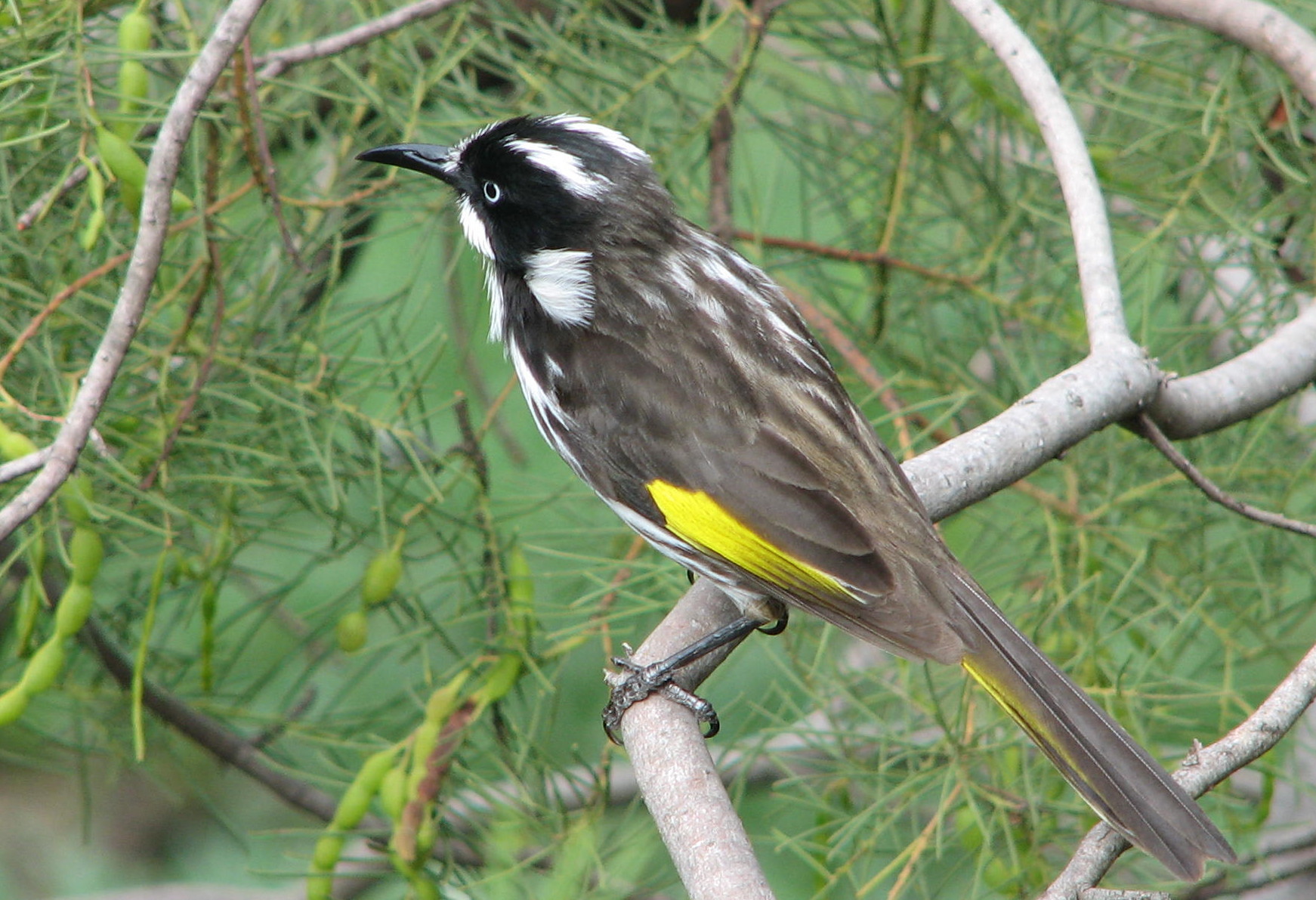
New Holland Honeyeater
Musk Lorikeets
While staying with my daughter in Clare in the mid-north of South Australia last weekend I was aware of the large numbers of Musk Lorikeets in and near her garden. Just over the fence in a neighbour’s back yard is a tall Eucalyptus citriodora (Lemon Scented Gum). It is about 10 metres high and covered in flowers. These are clusters of creamy stamens several centimetres long. And don’t the lorikeets love these flowers!
Lorikeets in the garden
While I was doing some gardening in the back yard on Monday morning I stopped a number of times to observe these raucous creatures. As they are feeding there is the constant contact calls, a relatively quiet screech – if that is not a contradiction in terms. They scramble all over and through the foliage seeking the next flower for its nectar. After a few minutes of this two or three of them would suddenly take off towards another tree, perhaps a few houses away or in the next street. Sometimes they would head arrow-like towards the park a block away, or towards the trees lining Lake Inchquin or the golf course next to it. As they fly they frequently emit high pitched screeches. You would have to be totally deaf not to be aware of these noisy birds zooming overhead.
Photo opportunity
As I watched one bird in particular I was aware that it was feeding on the outer foliage closest to where I was working. Of course the camera was inside. Would this flighty bird stay long enough for me to take a photo? I raced inside, grabbed the camera and crept as unobtrusively as I could back to my spot. The lorikeet in question must have been very hungry; he was still there. Over the next five minutes I managed to take some photographs, mainly of the foliage! Eventually I did manage a reasonable shot of the bird on the outside of the leaves and in full sun. The brilliant colours show up quite well, especially the bright grass green of the back and sides and the brilliant red forehead.

Musk Lorikeet
Lorikeets in South Australia
Lorikeets are widespread throughout southern South Australia. There in the Clare Valley the Musk Lorikeet seems to be the dominant species, but I have also recorded Rainbow Lorikeets from time to time. The Purple Crowned Lorikeet may also be found in this area. In Murray Bridge where I live, however, the latter species is the most common, followed by the Rainbow Lorikeet. The Musk Lorikeet is not observed nearly as much in our area.
UPDATE: for related articles and more photos click on these links:
This article was updated on October 3rd 2015.
Southern Boobook Owl
1 Comment »16th May, 2006; Category: Garden birds, Murray Bridge, Nocturnal birds, Owls Frogmouths and Nightjars
Cold Night
Late last Saturday evening we were travelling back from visiting relatives in Jamestown in the mid-north of South Australia. It had been a lovely autumn day, clear sky, lovely sunshine and no wind. As soon as the sun set, the air had a sudden chill, as if a frost was settling in for the night. We saw the full moon rising soon after sunset.
Night Driving Hazards
As we travelled past the pine forests south of Jamestown I was on the alert for kangaroos on the road. Nephew Steve had warned me before we left to be on the alert as he had killed four roos in recent years in that area. When travelling rural South Australia I am always on the lookout, usually for sheep that have strayed through fences on to the road. Kangaroos and, in some parts, wombats, are very dangerous hazards on our roads, especially at night.
Wombats
Fortunately I had hit very few kangaroos, probably about five, in all my years of driving in Australia. I have never hit a sheep or cow and I never want to hit a wombat. It would be like hitting a rock, I’d imagine. I came close to one crossing the road one night near Swan Reach. Scary!
Owl
Now back to the bird sighting last Saturday night. At first I thought there was a rabbit sitting on the side of the road. As it flew off into the darkness I realised my mistake. At first I thought it was a Barn Owl, but the markings were all wrong; it was too dark. It had to be a Southern Boobook Owl, one of Australia’s most widespread and best known owls.
Its “boo-book” call is a familiar nocturnal sound throughout rural Australia. It is even heard in built up regions where suitable habitat exists. I have only heard it on one occasion near our home in Murray Bridge despite it being resident in the area. We have heard it far more often in Clare near my daughter’s home. It is a species more often heard than seen.
Update: I’ve just recorded it for the second time in our garden. To read about it click here. The article includes a photo. Posted on 4th May 2010
Close Encounters of the Bird Kind
The male Golden Whistler is one of Austrlai’s most stunningly beautiful birds. When sitting perched in the early morning sun the golden yellow feathers almost glow. The colour of the breast feathers shine like a beacon lighting up the sometimes drab mallee or woodland habitats in which it lives.
Female Whistlers
The whistlers can be quite confiding birds in a garden setting. Earlier this week, as we sat in the plant nursery having a well deserved cuppa, a female golden whistler came to visit us. Now the female is as drab as the male is colourful. Plain brown at first glance, and rarely worth a second look in the presence of her amazing mate. True, I always do try to get a second look – just to check out if it is a female Golden Whistler and not a female Rufous Whistler. Both are common in this part of Australia but fortunately easily identified. The female Rufous Whistler has a streaked front.
Close Encounter
This individual allowed me to sneak closer and closer until I was about four metres away. Then I tried making kissing sounds and she became very curious. Eventually she came to within a metre of where I stood near a bush. Up close one is forced to overlook the apparent drabness of the female. She is, in fact, finely marked and just as beautiful, in her own right, as the male.
It was indeed a wonderful close encounter.
And of course – I didn’t have my camera with me. Still, I managed to get a reasonable photo of the female last week.
We later heard the male calling but he didn’t show himself.
Silvereyes
Silvereyes are small dainty birds with a white eye ring, hence their name. They are relatively common and widespread throughout the Murraylands region of South Australia. In my experience they seem to frequent parks and gardens. This species always delights me when I see it and they can be quite tame and approach one with curiosity.
Unfortunately, they do not seem to like our garden for some reason. We only see them infrequently, and then only fleetingly. On several occasions I thought I heard their call but didn’t have the time to follow them up and check them out. I did see a small flock fly over head but they didn’t settle long enough for me to be sure.
That’s where my wife’s main interest has an advantage over my birding.
Flowers, and the plants they are attached to, don’t tend to fly off.