Trevor’s Birding
  Subscribe       
   

Australian Magpies

Australian Magpie (Black-backed race)

Australian Magpie (Black-backed race)

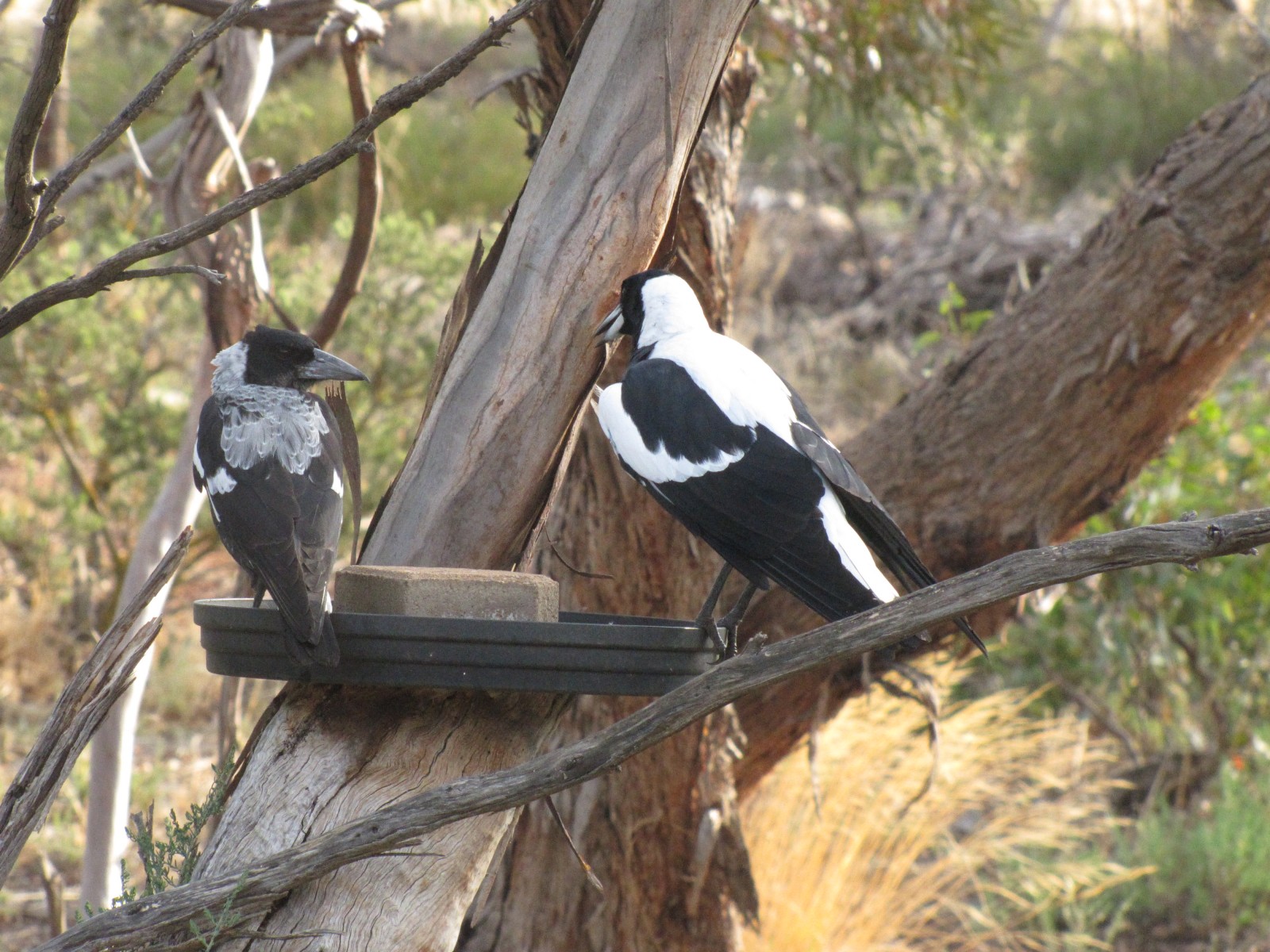
Yesterday I reported on the birds I have observed at Geranium, a small farming community in the Murray Mallee area of South Australia. One species that is very conspicuous is the Australian Magpie. On a walk around the school grounds and oval I was interested to observe two distinct sub-species of magpie present and interacting with each other.

Sub-species of Australian Magpies

There are nine recognised sub-species of magpies in Australia, including:

Gymnorhina tibicen or the Black-backed Magpie is the nominate race. Its back is mainly black and is widespread throughout eastern, northern and western Australia.

Gymnorhina tibicen hypoleuca or Tasmanian Magpie found in Tasmania.

Gymnorhina tibicen leuconota or the White-Backed Magpie occupies large areas of South Australia, Victoria and New South Wales. It interbreeds successfully with the Black-Backed Magpie.

Gymnorhina tibicen dorsalis or Western Magpie is confined to the SW parts of Western Australia.

Because there is hybridisation across the races this has led to the conclusion that this is in fact one species. Where they live together, such as at Geranium, there can be significant differences in the amounts of black, white and intermediate shades of grey, which can be rather confusing in the field.

Here at home in Murray Bridge the dominant form is the White Backed. I have only ever seen one black backed in the immediate district. As one travels east, however, you see more and more Black-Backed and grey backed individuals. Once in NSW or Victoria there seem to be far more Black-Backed than white.

Australian Magpie (White-backed race)

Australian Magpie (White-backed race)

References:
To read the Australian Museum article on this species click here. This article includes a painting and a photo of a magpie.

The Wikipedia article is also of interest as it has several good photos and an interesting supplementary article about the danger of magpies swooping in the breeding season.

The Field Guide to the Birds of Australia by Graham Pizzey and Frank Knight (1997 Angus and Robertson).

Correction:

This article was slightly corrected on 26th January 2010 on the advice of one of my readers. Thanks Tim.


70 Responses to “Australian Magpies”

  1. Denis says:

    Dear Mr Trevor,

    (the “Mr” thing is hard to do without, Old Continent habit), I could easily become quite heavy, so after some more questions, I will rapatriate a bit to my Antipodes, still being a remote observer of your exotic (for me) wildlife problems, and maybe give some advice on animal health, which is a problem I have quite a knowledge upon, and though, it seems, one can find affordable veterinary advice on your system.

    – In one of your old postings, I found a discussion on a feral cat which would no more kill birds. So, what is a feral cat in your precise legal definition, and what happens to them in that case ? In France, the definition has been restricted from “200 m from houses” to “1 km from houses”.
    When I came back to my family house in the Bordeaux vineyard, I had a lot of fighting with the neighbour hunters (which you cannot, since the Revolution, prevent hunting on your own land) who probably killed my beloved female cat of the time, which had come with me from far away, but who liked to go hunting quite far from our own property.

    – Is hunting allowed in Australia, and how is this leisure practised ? Are there many people concerned ?

    Thank you for your hospitality and have a good continuation of your nice and useful leisure. Best wishes.

  2. Tim Bowen says:

    Hello,
    Your comments about the White Backed Magpie are interesting. However, I note that you have identified the Gymnorhina Tibicen Hypoleuca as the White Backed Magpie that occupies South Australia, Victoria and New South Wales. This bird is actually known as the Tasmanian Magpie. The White Backed Magpie which occupies South Australia is the Gymnorhina Tibicen Leuconota and is also known as the Piping Shrike. It has be the Fauna Emblem of South Austalia since 1901 (as forwarded by Governor Tennyson in his dispatch to the Secretary of State for the Colonies). You may like to refer to the CSIRO, Australian Museum and Fauna Australia Websites to verify this information.

    Best regards

  3. Trevor says:

    Hi again Denis.

    Thank you for your comments – sorry about the delay in replying.

    Feral cats are a huge problem in Australia for they are largely responsible for the decline of many bird, mammal and reptile populations in this country.

    As far as I know there is no “legal” definition of a feral animal, but I understand that the general interpretation of the term would be: any non-indigenous animal or plant living a self sustained breeding non-domestic existence. Examples: pigs fenced on a farm are domestic, wild pigs roaming the forests are feral.

    Many introduced species now have huge self sustaining populations in Australia. Examples include House Sparrow, Common Starling, Common Myna and many other bird species, House Mouse, Brown rat, European Hare, Rabbits, various deer, goats, pigs, horses, camels etc. The plants would be too numerous to list here.

    Cats that are largely domesticated are free to roam as their owner allows though they are encouraged to house them indoors or in large cages or runs. In practice few people restrict them much at all. I don’t know if it is an offence to shoot or harm a neighbour’s cat – it probably is but the legality is blurred. If the neighbour’s cat was killing my aviary birds or chickens, I could probably apply to the local government council for a restraining order. I think I’d be in trouble if I shot it and the neighbour could prove I was guilty.

    Hunting is a different matter. As far as I know anyone with a gun licence (which is subject to a police check) can basically shoot anywhere, especially on private property. National Parks and reserves are an exception. The shooting and hunting clubs are a huge, well organised lobby group and hold strong political influence, especially where duck shooting is concerned. The duck shooting seasons are strongly regulated by government decree and restricted to certain dates only, usually only a few weeks each year. Feral species (foxes, rabbits, pigs, deer etc) can be hunted throughout the year. I would guess that there are over 100,000 active hunters in Australia, far more than active bird watchers (20-30,000??)

    Thank you for your interest.

  4. Trevor says:

    Hi there Tim,

    Thank you for your comments about the various races of Australian Magpies.

    You are right.

    When I wrote this article I was basing my conclusions on the Pizzey and Knight field guide (as referenced in the footnotes). Pizzey’s classification was based on older groupings which derived from John Gould’s work on Australian birds.

    Since writing this article I have purchased the definitive work on Australian birds – HANZAB. After a great deal of cross checking I have to concede that you are correct. This renaming is a relatively recent change.

    I’ve now changed the nomenclature in the original post above.

    Thank you for pointing out my error. Much appreciated.

  5. Trevor says:

    Hi again Tim.

    Just a small correction to what you wrote in your comments. When writing the scientific names of birds (and plants and animals etc) the genus name only is capitalised. The species and subspecies names are not capitalised.

  6. Denis says:

    It seems that some people in our part of the world start to be interested with the australian and New Zealand approach of wild life, with your strong distincton between indigenous and non-indigenous. Evidently, one understands your reasons, but maybe comes then the comparison to the equivalent human problem, very prevalent in Europe now and the history. Having parrots, which are evidently not indigenous species, but were born here, I have read that Australia does not authorize exportation of birds, even if some are so numerous as you said yourself. I understand that maybe, and I am near that opinion, (wild) birds should not be allowed in captivity, or at least not kept by any sort of person. But then, your population should not be allowed to own animals coming from other parts of the world as well (african parrots ?).

    Good bye again. I have found a European site for corvidae. Maybe I will transmit to them some of your appreciations, if you do not forbid.

  7. Denis says:

    One more point : then, in the Old World, there could be no feral animal, cats and others being indigenous, at least for some thousands of years. That does not prevent the law to make corvidae and others as “nuisible” and killable animals.

  8. Jenny says:

    Hi Trevor, or anybody. For around 2-3 years I’ve fed a male magpie (named Max). He used to come with his mate and then sometimes with their offspring. He eats out of my hand.

    Just over the last 3 days he’s turned up by himself and he appears to be injured. From observation his leg appears to be broken as it’s very distorted and when he’s on the ground he gets around by hopping or moving very awkwardly. He take a lot of food from my hand (maybe having trouble feeding normally in the wild).
    I’m very concerned about him. We tried to capture him so we could take him to the vet to see if anything could be done for him but he flew away (thank goodness at least he still has that skill). But his features are ruffled and I don’t think that’s a good sign because he’s obviously under stress (and pain)

    Any suggestions? I’d probably put his age at around 5 because as long as I have been feeding magpies he’s aways been around.

  9. Jane says:

    Hi Jenny !
    I really feel for you and Max! We fed a male for many years – and eventually his mate, then he turned up with a badly broken leg and a cough, mid to late last year. He did get better as time went on, and did fend for himself and his mate and looked after a nest and baby! He sadly has disappeared in the last month or two. Last time we saw him he was sitting on the footpath singing to us as he always did. Sometimes it is better to let nature take its course, vets are limited with bird leg injuries I think. But we still have his mate Jackie visit, and now 3 young, from where we are not sure, whom we have named Larry, Curly and Mo. It is a bitter but beautiful circle of life in the bush.

  10. hannah says:

    hey there i have raised a white backed maggie i found after a storm. i have since moved to a new town and have 4 abandoned baby magpies living in my yard 3 are doing great but the other one isnt she cant walk well or fly and is missing the tips of her beak. she is very tame and will come close to me.. is there any way i can feed her i give her a bit of mince sometimes and bugs. her other siblings seem to worry when she doesnt stand up and call out…i though she wouldnt ive long but its been about a month now. have u got any sugggestions on how i can help her with out catching her! or some food that may help her get stronger…

    anything you have will healp thanx

  11. Prue says:

    Hi
    I have recently found 4 dead adult Magpies, 3 around our small house and one a few doors away in the driveway. Is this a high rate? One was today, one was yesterday, one was 8 days ago, & one was 2 wks ago. We have a high street population as one household has fed them for many years. I heard that the neighbours had complained to the local council about the magpies gathering at this house each morning & evening, and I am concerned that the recent spate of deaths might be that someone is baiting them. Then again it may be normal mortality for winter. I love our local magpies, does anyone have any comment?
    thanks
    Prue

  12. Jane says:

    Hi Prue
    Seems I am first to reply….I am no expert, but unless these birds are showing obvious signs of being attacked by predators, I would have to agree that baiting would be what maybe going on in your street..
    This would be my nightmare situation finding all these dead birds.
    I have only seen two of my lovely birds disappear/die in the last few years, and they had been injured prior to this. They tend to be hardy individuals. It may well be worthwhile to make a phone call to council or police yourself, as this just does not seem right.
    To think that people cannot have pleasure in their morning songs is unbelievable – to me! The more the merrier I say!
    Jane

  13. Clem says:

    Hi Prue
    I agree with Jane. A similar thing happened here some year or so ago. If you look back over these comments, you’ll see my experiences with a family nesting close to our house in Kingaroy. The “babies” are now almost fully grown and have their own characters.
    What I was getting to though, was that we only feed spasmodically so the birds don’t treat it as “normal”, and every time they come and sing to us they aren’t always rewarded with a treat. We also vary snack times and it’s only that.. a “snack” not a meal. Even so “Dad” and also one of the babies take it from my hand.
    Perhaps you could relay this to the folk near you who are feeding, as our method prevents any congregation of the magpies and hence no offence taken by neighbours.
    Sorry about your loss though, and I fully empathise.
    Clem

  14. Jenny says:

    Hi, how could anybody be so cruel to such wonderful birds! I’ve had a family which came around to us on a regular basis over a period of 4 years. The parents have had babies; they grew up and disappeared but have since appeared back again as adults. I have watched my original family slowly disappear due to old age, injuries, illness etc. The worst was my regular “boy” who turned up in the summer with what was obviously a broken leg. But somehow he managed to fly and was still able to feed. We did try to capture him to take him to the vet – but no luck…. Then he never appeared again, and I can only imagine he went to that big “Magpie House in the Sky”.
    I love having the magpies around. They’re great company! They don’t mess. And if I caught anybody being cruel I wouldn’t hesitate to take action, believe me!

  15. Prue says:

    Dear Jane, Clem and Jenny
    I really appreciate your replies. I really hope I am wrong about the baiting, but I will ring the Council (and maybe RSPCA or some other organisation)and alert them. We have been living at this house for 1 yr and interact with the magpies a lot. The small numbers of magpies over winter seems strange after all the wonderful individuals we have seen frolicking over spring and summer.

  16. Jessica says:

    Hi,
    I’ve never really been a “bird person” but over the last 18 months or so, I have had 2 visitors on a fairly regular basis. One is Marmaduke and the other is Marmalade. I love them – they are funny and cheeky and just have really nice personalities.
    One thing that I do find interesting is that Marmaduke has identification tags on his legs – not dissimilar to what the council used to give for dog collars. I can’t see what is written on them, but does anyone have any idea why the tags would be there? Thanks.

  17. Serena says:

    Hey everyone! Its great to hear about other people’s love for Magpies; I think if any bird could be likened to a puppy, a Maggie can- the way they play and wrestle with one another as babies, and the excited way they run up to you along the ground when they see you.

    We have a `new couple’ in the area and the young female runs up to us in the mornings (not flies) with her wings outstretched, wiggling them with joy and anticipation of getting a treat. Her mate was a juvenile last year who was newly booted out from his parent’s territory. He stayed with us all winter, just sitting in a tree for most of the day trying to stay safe & practicing songs and calls. Then he eventually moulted from grey to black & white, and made friends with a group of young crows. So he became a bit more adventurous with them as friends, then and found his mate early this year. Its sooo nice to see them with a territory of their own now. He seems too young to breed (I read they don’t breed until 3 yo) but he is already protecting his mate and they do everything together.

    Sadly, I also know a disabled Maggie. I met her 4 years ago, and she had a type of hip displasure that made walking uncomfortable & slow. We called her `busted’. We fed her and her mate daily for 3 years, and then moved house and stopped seeing her for a year. But just recently, we started taking long walks in the morning to see if she was still around, and she was ! But this time she had another bad leg problem & one foot was bunched up & useless from some sort of ankle break. She moved slower than before, but oddly looked healthy and well filled out. We started seeing her every 2nd or third day again, and this week she has turned up with her one good foot broken, and she has to land on her bunched up foot, then rest on her tummy because she can’t walk.

    I am now feeding her twice a day until her leg has mended and she can hobble again. I think for her to have survived all these years, some angel must live near by who looks after her and makes sure she is fed. She is tame & beautiful natured , like a pet. I just hope she makes it through the next 2 weeks and she can walk again after this last nasty accident.

    Its horrible seeing these kinds of injuries, but also so amazing to see how hardy Magpies can be.

  18. Lesley says:

    Trevor, thank you for setting up such an interesting forum.

    We’ve lived in the same house for 14 years and ever since the first night we moved in we have had a magpie living in the area that appears to ‘snore’. Thankfully not always outside our house but often enough.

    The ‘snoring’ appears to be the first 3-4 notes of a carol, then a pause of several seconds then the same notes repeated but never a full carol. This goes on through most of the night (and when he/she is in the tree outside the bedroom window, it can drive you up the wall!). We think it is part of a group of about five birds, but we only ever hear one doing this.

    Can you (or any of your observant guests) enlighten us?

    With thanks.

    PS: I once saw this group escort a neighbour’s cat across the road and away from their favourite spot (not in nesting season). There was a bird either side of the cat and one behind it. At one stage the cat sat down and started to groom – the magpie behind it stepped up an tweaked its tail and the cat beat a hasty retreat under its house. The magpies immediately started a prolonged carolling that had a bit of a triumphant, jeering note.

  19. Trevor says:

    Thanks for your kind words Lesley, and for adding to the discussion.

    What you are hearing is called the nocturnal song of the Australian Magpie. It has been extensively studied and well documented in publications like the Handbook of Australian, New Zealand and Antarctic Birds. The entries go on for many pages and too extensive to quote here. It is most common on moonlit nights, or in localities where there are street or security lights. We often hear it in our own garden, but thankfully not right next to our window.

    Good to see that your local magpies are making a stand against the local cats!! LOL.

  20. Lesley says:

    Ah! I’ll have to look it up at the library. Thanks for the heads up on when it is likely to happen. Must have a chat with the Council about the lights out time in our area! I like magpies, but I do enjoy sleeping too.

    Many thanks Trevor.

    PS I now have a ready response to snoring jibes!

Leave a Reply