How to Attract Birds to Your Garden
One of the great and constant delights I have in my interest in birding is to witness the constant movement and activity of birds in our garden. Many of the articles on this blog come directly from observations of birds in the garden. Many of the photos appearing on this blog and in my photo gallery have been taken in the garden or nearby.
People who have an interest in birds often ask “How can I attract more birds to my garden?” There are some simple ways of ensuring a greater number of birds in your garden which will, in turn, bring many hours of pleasure over many years. Here are some simple “rules” to help you:
- Water: Provide a constant source of water, such as a pond, bird bath or dripping tap into a bowl.
- Food: Provide a variety of native trees and bushes that become a suitable food source. (In Australia – never put out food like parrot seed for them).
- Protection: Never let your cat roam the garden – and actively discourage neighbour’s cats from entering your garden.
- Safety: Provide a safe environment for the birds by not using any poisons like snail bait in your garden.
These are simple and effective methods of ensuring a safe and happy habitat for the birds in your garden.
For more information, go to the Bird Observers Club of Australia website. They have available two downloadable leaflets on attracting birds to your garden. Highly recommended.
Links:
- Attracting Birds to your Garden – part 1
- Attracting Birds to your Garden – part 2
- Bird Observers Club of Australia – one of our largest birding clubs.
- Garden Birds – over 80 articles from my archives about birds in gardens, mostly our garden.

New Holland Honeyeaters
Galahs come for a swim
The hot and very dry conditions in our district over this summer have produced many visitors to our bird baths. (Click on the category “Bird Baths”) The other day, however, I was alerted to a flock of noisy Galahs in another part of the garden. About sixty Galahs had settled in the trees near our swimming pool (read “Swamp” – it is green because we have not maintained or used it this summer).

Galahs
Some of these Galahs decided that they needed a drink, so they settled on the brick paving around the pool. The water level was far too low for them to reach the water. This was because of the water restrictions during the current drought here. It made a spectacular sight and they allowed me to approach quite near before they flew off into nearby trees.

Galahs
White Browed Babblers and water
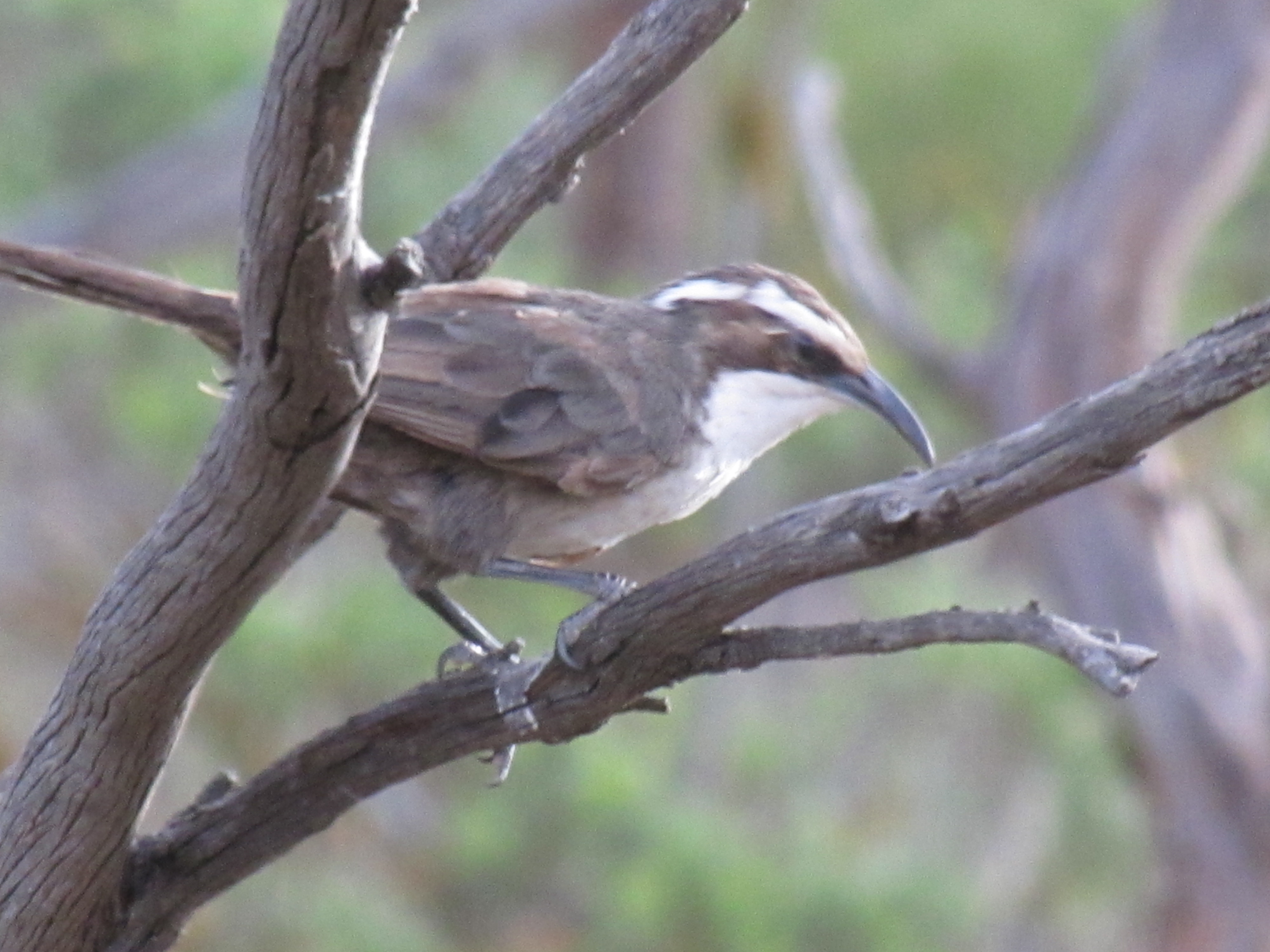
White-browed Babbler
I’ve written a number of times about the birds that come to visit the bird baths in our garden (see the links below).
We are constantly delighted to see the stream of honeyeaters, pardalotes, parrots and many other species that come to drink. Some linger awhile to bathe. Some are tentative in their approach, others come in boldly, chasing away any who may linger too long.
White-browed Babblers
White-browed Babblers are frequent visitors to our garden. They come in their family group, scuttling through the low bushes, scurrying up the branches of the mallee trees searching for insects and spiders and filling the air with their cat like calls.
From time to time their foraging antics bring them close to the bird bath. Sometimes they get as close as a metre away. I have never seen them land on the bird bath, let alone take a drink or bathe.
I recently read a series of posts on the Birding-Aus forum that many species of birds do not need to drink, or drink very infrequently. They manage to gather enough moisture from the insects, beetles and spiders they eat.
Related Articles:
- Birds in the heat – birds that visit during hot weather
- Birds and communal bathing – water wasters at work
- Time for a bath – a long list of birds and animals which come to our bird baths
Updated November 2013, and September 2015
Silvereyes come to visit
Silvereyes are delightful little grey and olive-green birds – unless you happen to have ripe grapes on your grape vines, when they will descend upon your garden with great delight and feed on the grapes using their sharp pointy beaks to pierce the skin of the grapes.

Silvereye
Silvereyes are found throughout eastern and south-eastern Australia, as well as south western Australia. There are several races recognised with each race having distinctive colour variations. The white eye ring is conspicuous and diagnostic. Two similar species, the Pale White-Eye and the Yellow White-Eye are found in northern Australia.
Their thin call (‘psee’) as they pass by in loose flocks is a common call in many parts of their range. I’d been hearing this call in our garden for some weeks, so they have been around. Tracking them down is another matter as they tend to be a little sneaky around here. Finally one came to the bird bath for a drink, so I was able to get a reasonable photo.
They haven’t caused us any angst in the orchard – yet. We don’t have any grapes on our vines this year. I wish I could say the same about the Ringneck Parrots; they sometimes eat our pears before we get to them, and before the pears are ripe. We were sneaky and stripped the trees before they did too much damage this year. Now we have to wait for the pears to ripen.

Mallee Ringneck Parrot