The flight of the baby honeyeater
This week we have had some horrible weather. Hot days over 40 degrees with dust blowing wildly from the parched north of the state suffering the worst drought in living memory. Thankfully it is a little cooler today.
During the hot weather I saw a baby New Holland Honeyeater that appeared to have just emerged from the nest. He was hovering like a little helicopter, not being really sure what this flying business was all about. It must be difficult in good conditions; trying to learn to fly when it is so hot and so windy must be a tremendous challenge.
This little one settled long enough for me to get this photo. I then quickly retreated because Mum and Dad were nearby, fussing around with more food for this hungry youngster.
Related article:
- Why do baby birds disappear? An article I wrote recently in response to a reader’s question about baby birds.

New Holland Honeyeater (baby just out of nest)
Why do baby birds disappear?
16 Comments »18th November, 2006; Category: Baby birds, Bird Behaviour, Cuckoos, Frequently Asked Questions, Garden birds
One of my regular readers recently asked the question: “Why do baby birds disappear?” We had been corresponding during the recent height of the Australian breeding season. Spring here is coming to a close, but many birds are still actively making nests, sitting on eggs or feeding young in the nest or just out of the nest. This reader observed that many baby birds go missing. What happens to them, she asked.
Here is my reply:
It is very distressing for bird lovers to see the little birds disappear or be killed in some way so soon after hatching or leaving the nest. If we knew the figures, I think we would be horrified by the enormous attrition rate in our fauna, not just birds.
Some possibilities include the following:
1. Removal from the nest by cuckoos. We have several species of cuckoos in Australia. The female lays one egg in a host nest. This could be a thornbill, honeyeater or a range of other species. The host bird hatches the eggs and the baby cuckoo hatches first and it removes all other eggs in the nest in the first hour or so after hatching. It then gets ALL the food from the host parents. Harsh yes – but this is normal, natural cuckoo behaviour.
2. Predation of eggs or chicks: this could be from ravens, crows, currawongs, butcherbirds, hawks and even magpies. Cats, foxes, snakes and lizards, especially goannas, will also raid nests.
3. Predation out of the nest: Once fledged and out of the nest the young birds run the gauntlet of so many hazards including all in number 2 above. Add to those hazards the problem of being hit by speeding cars, wild storms, flying into glass panes (very common), captured by well meaning people and not cared for properly, heavy rain, cold nights and so on.It is a wonder that any survive at all, especially in urban areas. This is in part compensated for by the following strategies:
(a) Laying 3-5 eggs for each clutch as this increases the success rate
(b) cleverly camouflaging the nest – with all my experience I am still fooled by their cryptic nest sites.
(c) breeding two or three times in one season.It would certainly help if all cat owners were responsible and made a run for their animals. This would eliminate some deaths in our fauna, but a far greater problem is the feral cats. There is no control of these and all are very big, strong and cunning. I think compulsory desexing of cats is the way to go, but it would only be a start. Catching all the feral cats is probably not feasible. Making sure no more are added to their ranks will be a good start though.
Related articles:
- Common Blackbirds – the article that started it all. The many comments are very interesting reading.
- Do Blackbirds Swoop? How to deal with aggressive bird behaviour – another article I wrote about Blackbirds. This one also created a great deal of interest with many interesting comments.
- Magpies behaving badly – Australian Magpies have a bad reputation during breeding season.
- A bit on the nose – an amusing incident involving a cyclist, a swooping Red Wattlebird and a nose.
- Anyone for a swim? Forget it baby Blackbird. Now this is something different.
Crested Pigeon caught by surprise
Crested Pigeons are common birds in our garden and on our five acre block of land. They regularly come to visit the bird bath and have been breeding regularly over the years. We often see 15 to 20 or more sitting in a loose flock on the power lines bordering our property.
Yesterday, while hanging out the washing on the clothes line I observed one very surprised Crested Pigeon. He flew down from a nearby tree, under the clothes already on the line and landed not more than a metre from where I stood. For a brief second he paused, looked at me and then, a little startled, flew back to the tree again.

Crested Pigeon
I enjoy hanging out the washing. It gives me a break from the computer and gets me fresh air. It also gets me out where the birds are, and this I enjoy because over the years I have made some great observations while completing this task. The eyes are naturally looking up and I see things like eagles, kites, hawks, swallows, ibises and many other birds flying overhead. I live in hope of someday seeing some swifts in this way too.
Time for a bath: visitors to our bird bath

Brown-headed Honeyeater
Some years ago we set up a birdbath on our patio area. It gave us much pleasure to see birds coming to drink and bathe. More recently we moved it to the other side of the house. Now it is in full view from our sunroom. It is here we often eat our meals, and work at the table with the birdbath in full view.
Over recent years, this location has had four main benefits:
- It is a great time waster investment; watching the birds go about their daily lives just a few metres from where we are sitting is both relaxing and refreshing to the body, mind and spirit.
- It is most entertaining, especially when a bird like a Mallee Ringneck Parrot comes to bathe and the water sprays in all directions.
- It is excellent for photography; with the 12X zoom on my camera, I have taken many close-up shots of the birds visiting. (Update: my new camera has a 20x zoom. Further update: I now have a camera with an 83x zoom.)
- It is educational; our human visitors marvel at our avian visitors and this gives us the opportunity to further enhance our friends’ appreciation of the natural environment.
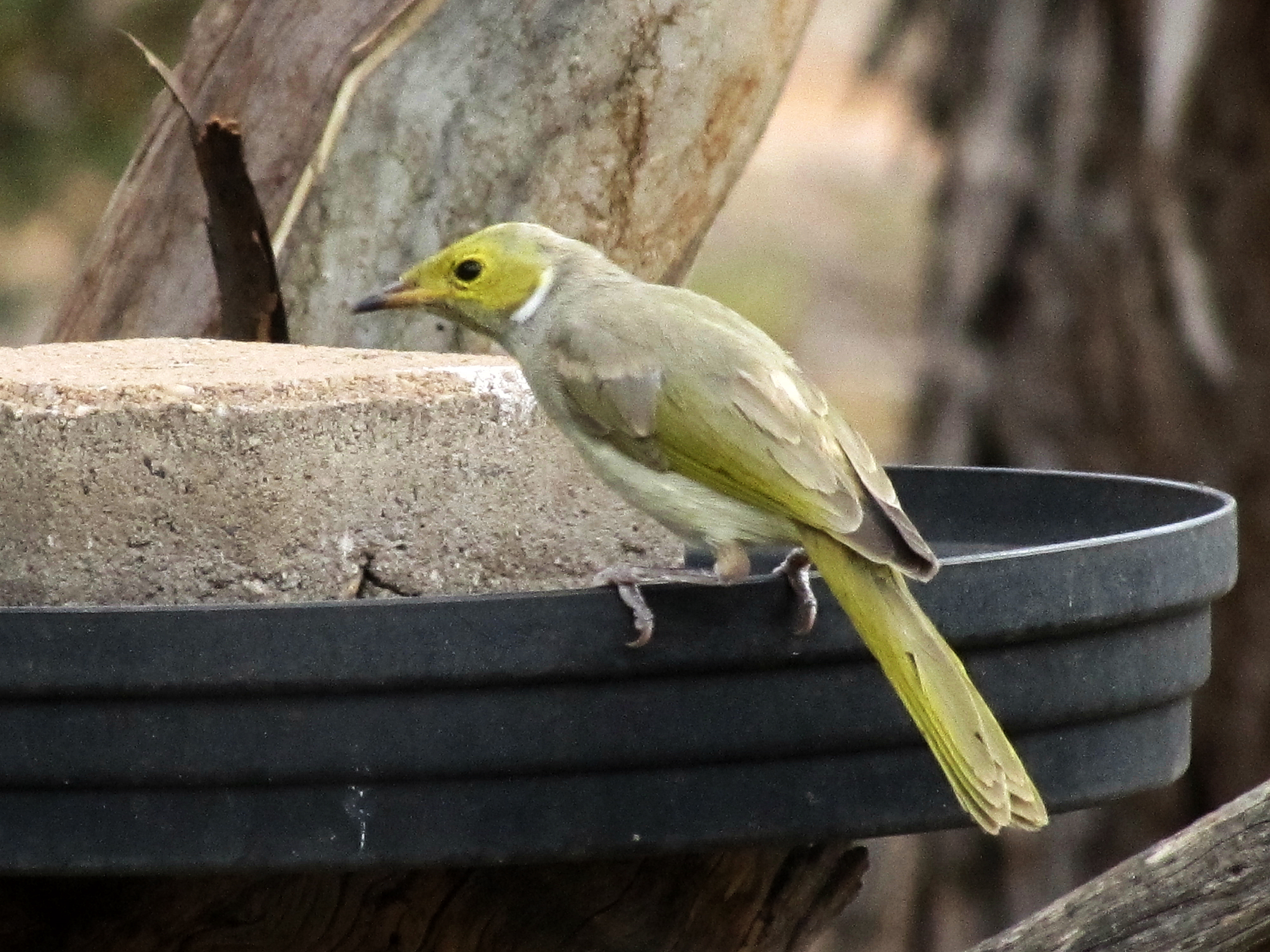
White-plumed Honeyeater
I’ve actually installed three different baths in close proximity to one another; one on the ground (which the lizards sometimes use too), one at a height of about 60cm and the third at about 1.5m. This gives them choices. The nearby branches and bushes give them a place of refuge if they feel threatened in any way.

House Sparrow (male)
A List of Species that have visited our bird baths:
- Mallee Ringneck Parrot
- New Holland Honeyeater
- Spiny-cheeked Honeyeater
- Red Wattlebird
- Brown-headed Honeyeater
- Singing Honeyeater
- White-plumed Honeyeater
- House Sparrow
- Common Starling
- Little Raven
- Willie Wagtail
- Spotted Turtledove
- Crested Pigeon
- Spotted Pardalote
- Striated Pardalote
- Diamond Firetail Finch
- Yellow-rumped Thornbill
- Grey Shrike-thrush
- Australian Magpie
- Magpie Lark
- Mistletoebird
- Common Blackbird
- Rufous Whistler (see updates below)
- European Goldfinch (see updates below)
- Chestnut-rumped Thornbill (see updates below)
- Grey Fantail (see updates below)
- Black-faced Cuckoo-shrike (see updates below)
- Galah (see updates below)
- Grey Currawong (see updates below)
- Eastern Rosella (see updates below)
- Sacred Kingfisher (see updates below)
- Dusky Woodswallow (see updates below)
- White-browed Babblers (see updates below)
- White-winged Chough (see updates below)
- White-browed Woodswallow (see updates below)
- Purple-crowned Lorikeet (see updates below)
- Animals
- Red Fox
- Stumpy-tailed Lizard
- European Rabbit
- Brown Snake
- Blue-tongue Lizard
That’s quite a list!
UPDATE: More recently we have added the following species to the list:
- Rufous Whistler
- European Goldfinch
- Chestnut-rumped Thornbill
UPDATE #2 Two more species to add to the list:
- Stumpy-tail Lizard (also called a Shingleback Lizard)
- Red Fox – yes, that’s right, a fox.
- Brown Snake – passed close to the bird bath on the ground. In January 2016 a metre long Brown Snake actually stopped to have a drink. See photos here.
UPDATE #3 Another species to add to the list: Grey Fantail – it came to the bird bath briefly but left before I could take a photograph (4th May, 2007)
UPDATE #4 In January 2008 we had a single Black-faced Cuckoo-shrike come to drink briefly from the bird bath.
UPDATE #5 In late January 2008 a single Galah came to within a metre of the bird bath but did not drink. A few weeks later I added Grey Currawong to the list.
UPDATE #6 In December 2008 I added European Rabbit to the list.
UPDATE #7 In December 2009 I added Eastern Rosella. (Click here for a photo)
UPDATE #8 In November 2013 a Sacred Kingfisher perched about a metre from the bird bath but did not drink. In February 2014 a Dusky Woodswallow came to drink during one of our heat waves during a very hot summer.
UPDATE #9 In September 2015 I added White-winged Chough, White-browed Babbler and Blue-tongue Lizard (click for photo)
UPDATE #10 In December 2015, during a heatwave, I added White-browed Woodswallow.
UPDATE #11 In December 2020 I added Purple-crowned Lorikeet.
Comments: many of my readers have commented on this post – read them below and leave one of your own.
Update: this post was last updated on December 2020.

Mallee Ringneck Parrot

Mallee Ringneck Parrot

Mallee Ringneck Parrot
Australian Hobby
I was out in the garden a few minutes ago. I was checking to see if the vegetables needed watering. I heard the warning calls of a variety of honeyeaters, especially the New Hollands, and this is usually a signal for me to scan the sky in all directions, looking for a bird of prey.
Sure enough, what looked like an Australian Hobby went skimming across the property at tree level, scaring the smaller birds silly. I can’t be 100% certain it was a Hobby, as I didn’t have my binoculars with me, but the shape, size, wing beat, manner and general appearance indicated that species.
The Australian Hobby (also called Little Falcon) is found throughout Australia but is not common anywhere. I have observed it on a number of occasions up the hill from home, about a kilometre away so it is not an unexpected visitor.
I have not yet been able to get a photo of this species so you will have to click here to see one.