Crested Pigeons as pet birds

Crested Pigeon
I recently had a rather interesting comment on an earlier post of mine about Crested Pigeons (see Great Birding Moments #5 Crested Pigeons).
Karen wrote:
I have a crested pigeon sitting on my shoulder at the moment. I went for a walk one morning and saw her on the footpath. She ran towards me, not usual pigeon behaviour. I picked her up, she cooed and closed her eyes. I took her home and fed her and she has stayed. She follows me around the house and is the most inquisitive bird I have ever known. She is quite content to be scratched around the head and calls to me whenever I enter the room. She was obviously someone’s pet but I had no success in locating them. I originally had intended to feed her up and let her go again but she is so tame she would have been a danger to herself. She lives with my 3 cockatiels and probably thinks that she is one.
What an amazing experience! Karen is certainly right in deducing that it is someone’s pet, because the behaviour is certainly consistent with a bird that has been used to being handled.
Crested Pigeons are reasonably common in aviculture, especially in zoo collections. This species normally requires a large planted aviary and will breed readily in captivity.
I find it interesting that it is quite at ease in her home and with the Cockatiels. It must make her day very pleasant to have such a lovely team of bird friends to keep her company.
She is probably right that it is safer in her home rather than fending for itself in the wild. If released, it would probably be taken by a hawk very quickly as it would not be as alert to the dangers presented by living life in the wild.
Please note: the laws about keeping native Australian birds in captivity varies from state to state. Please check with the relevant authorities before adopting birds. Your state National Parks and Wildlife website is a good place to start. You local pet shop should also be able to help.
Update: This article was edited and updated in July 2015. The photos below were also added.
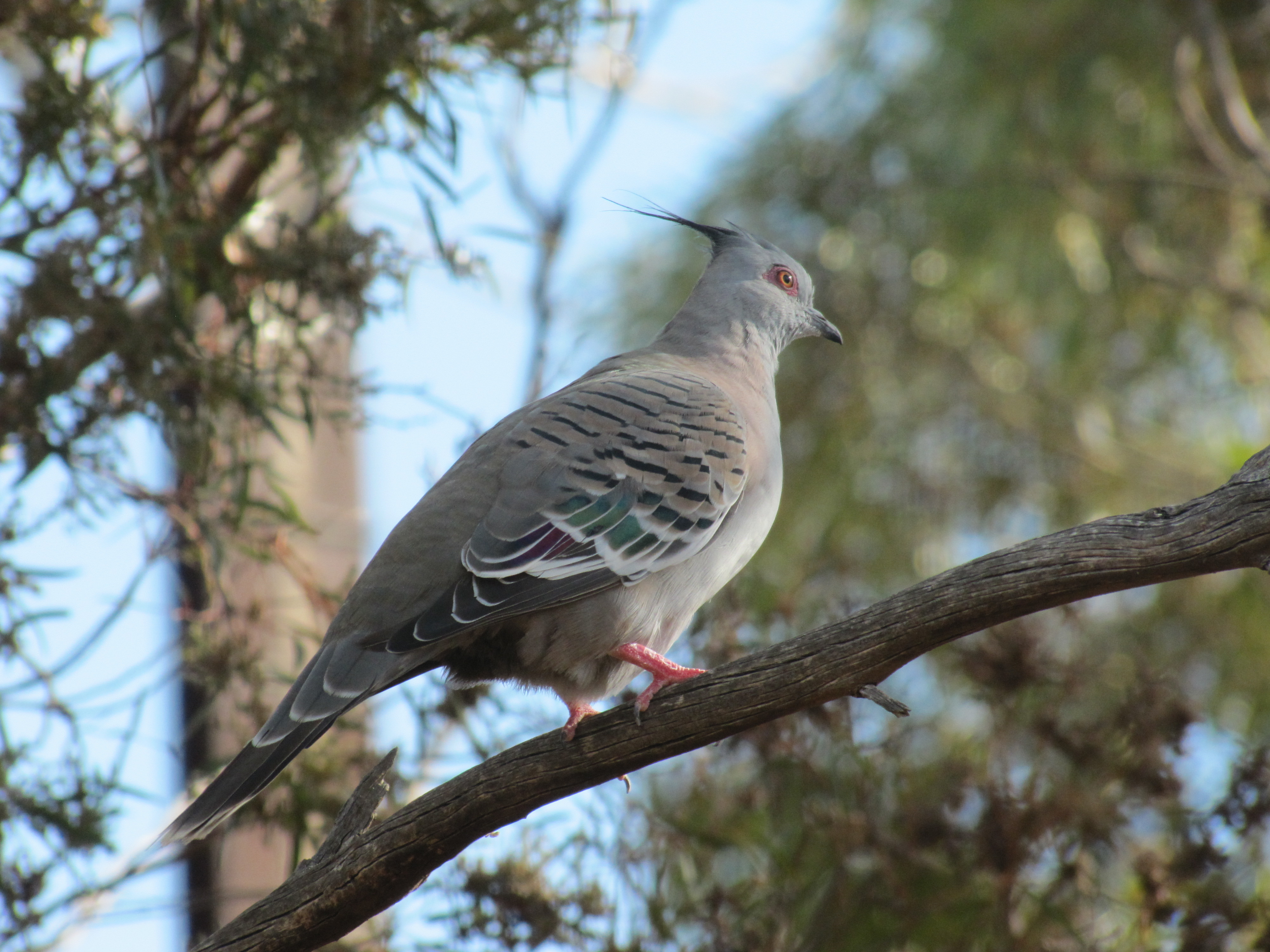
Crested pigeon
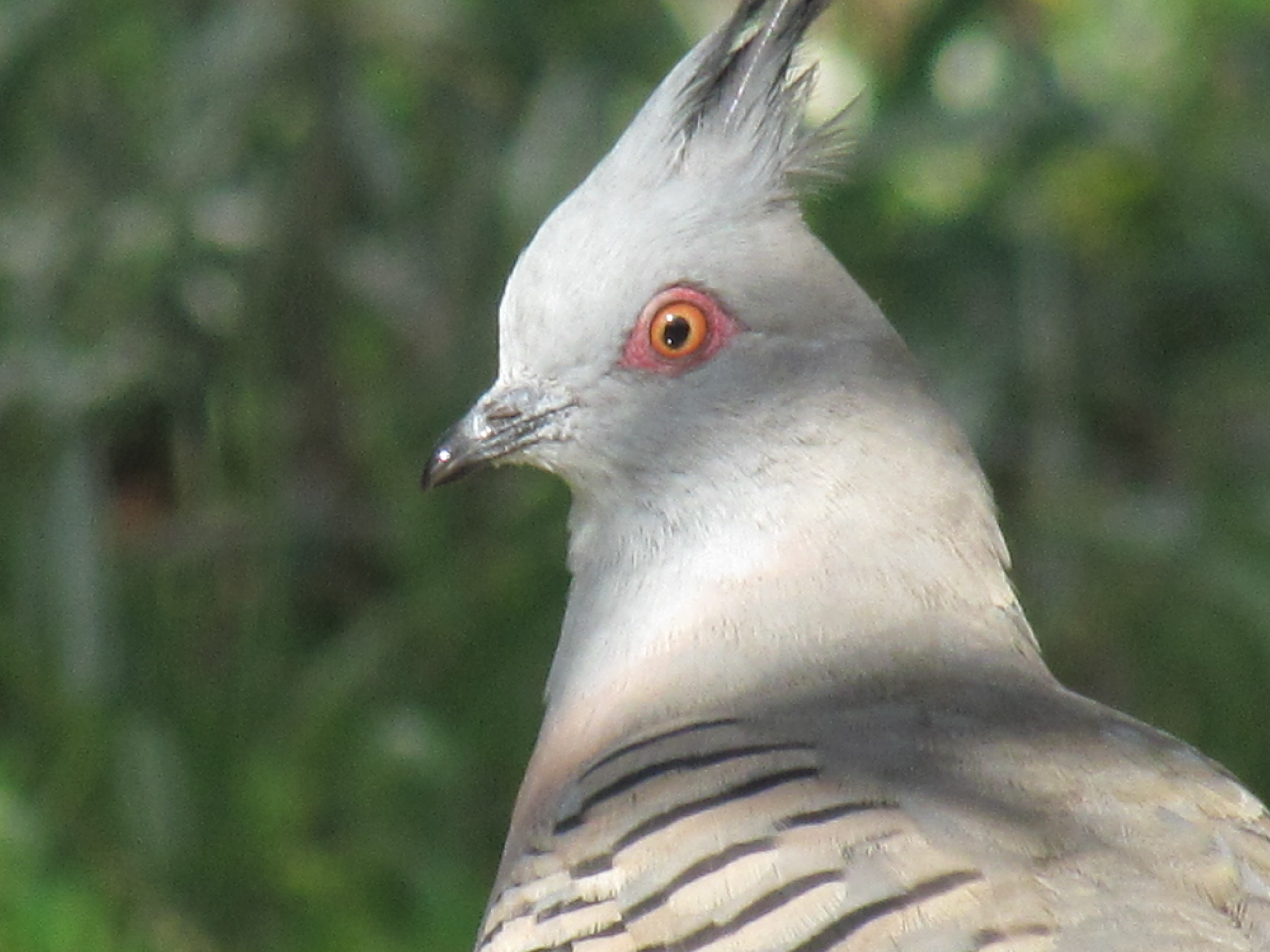
Crested Pigeon
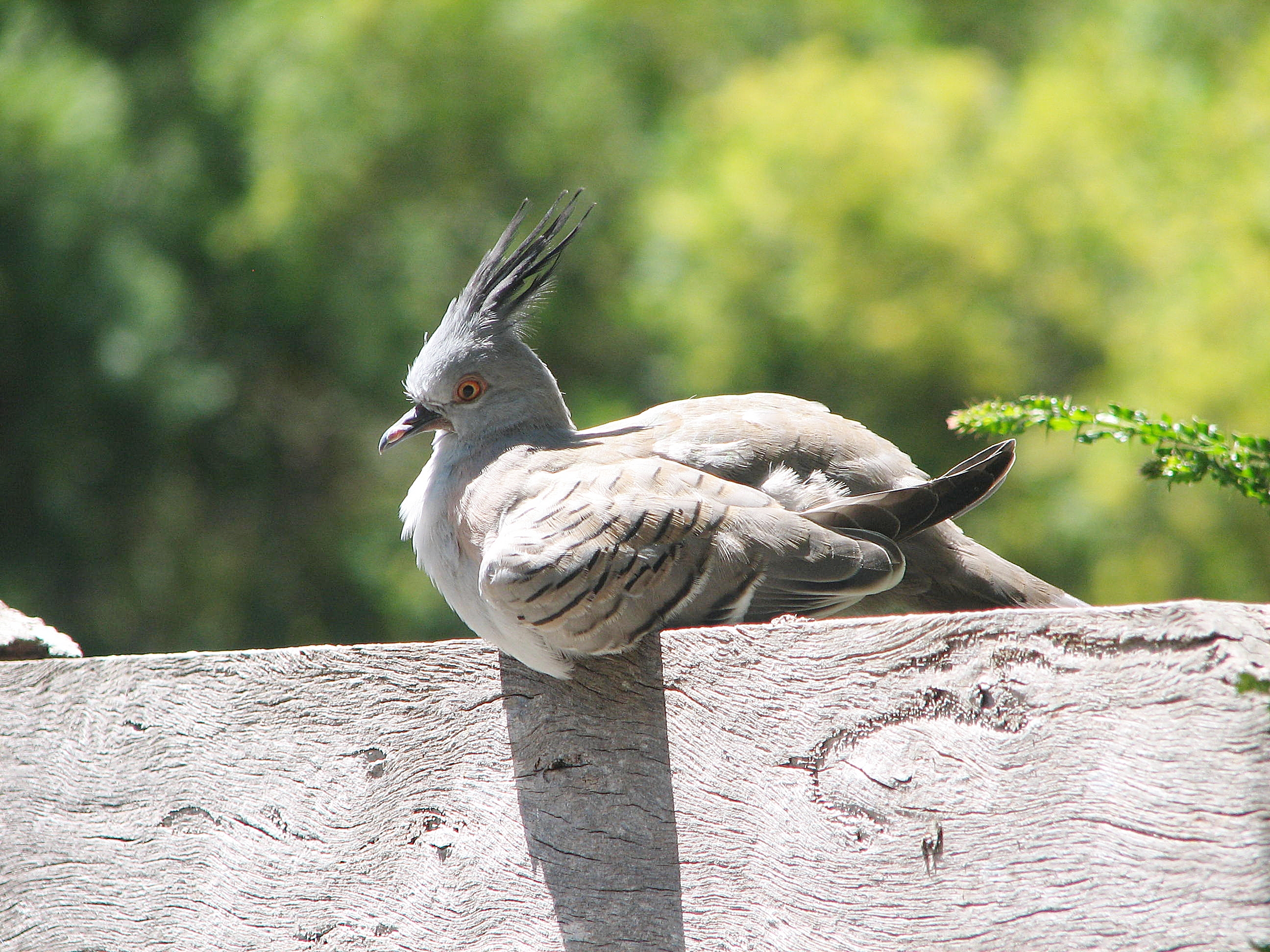
Crested Pigeon
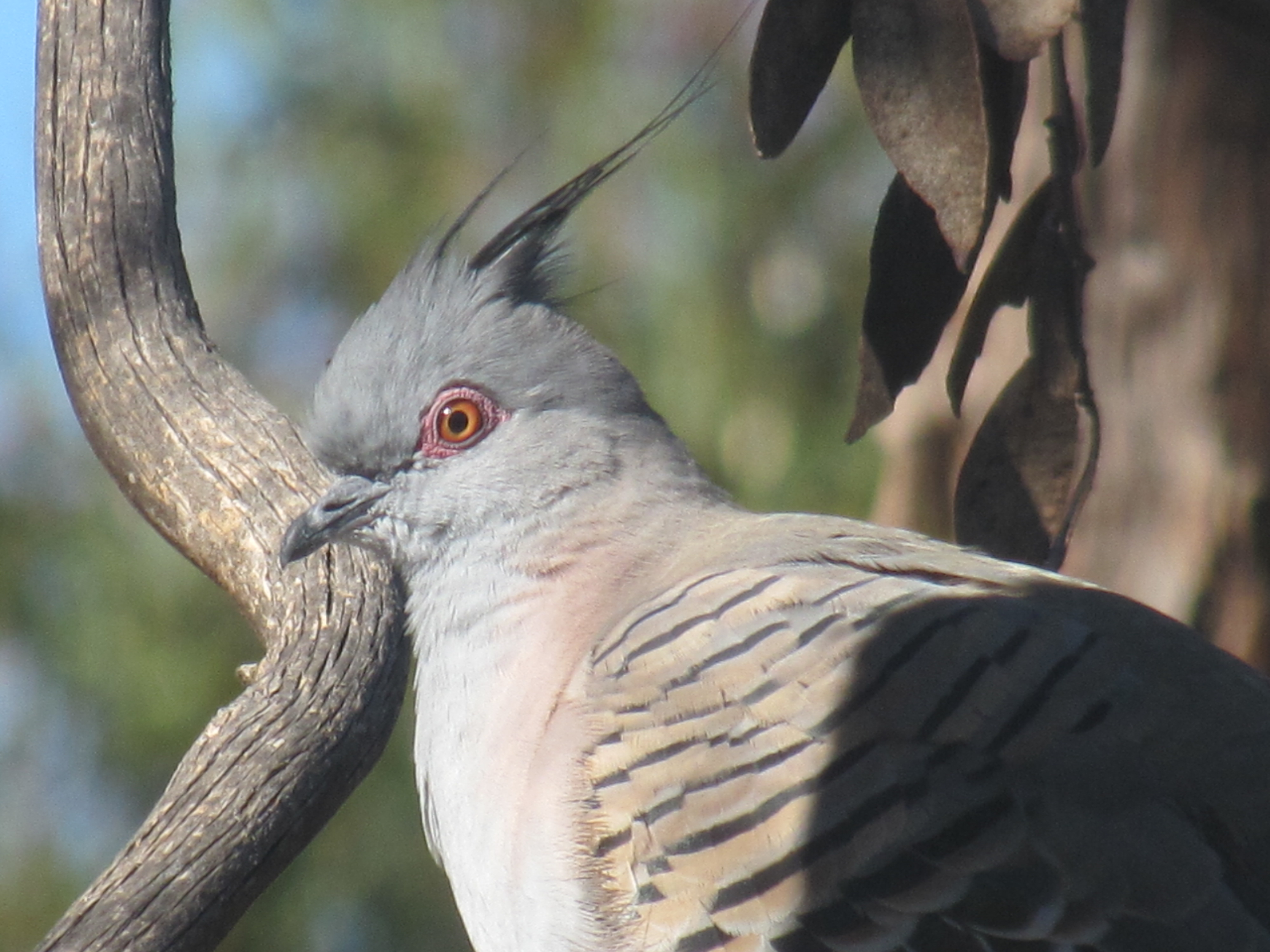
Crested Pigeon
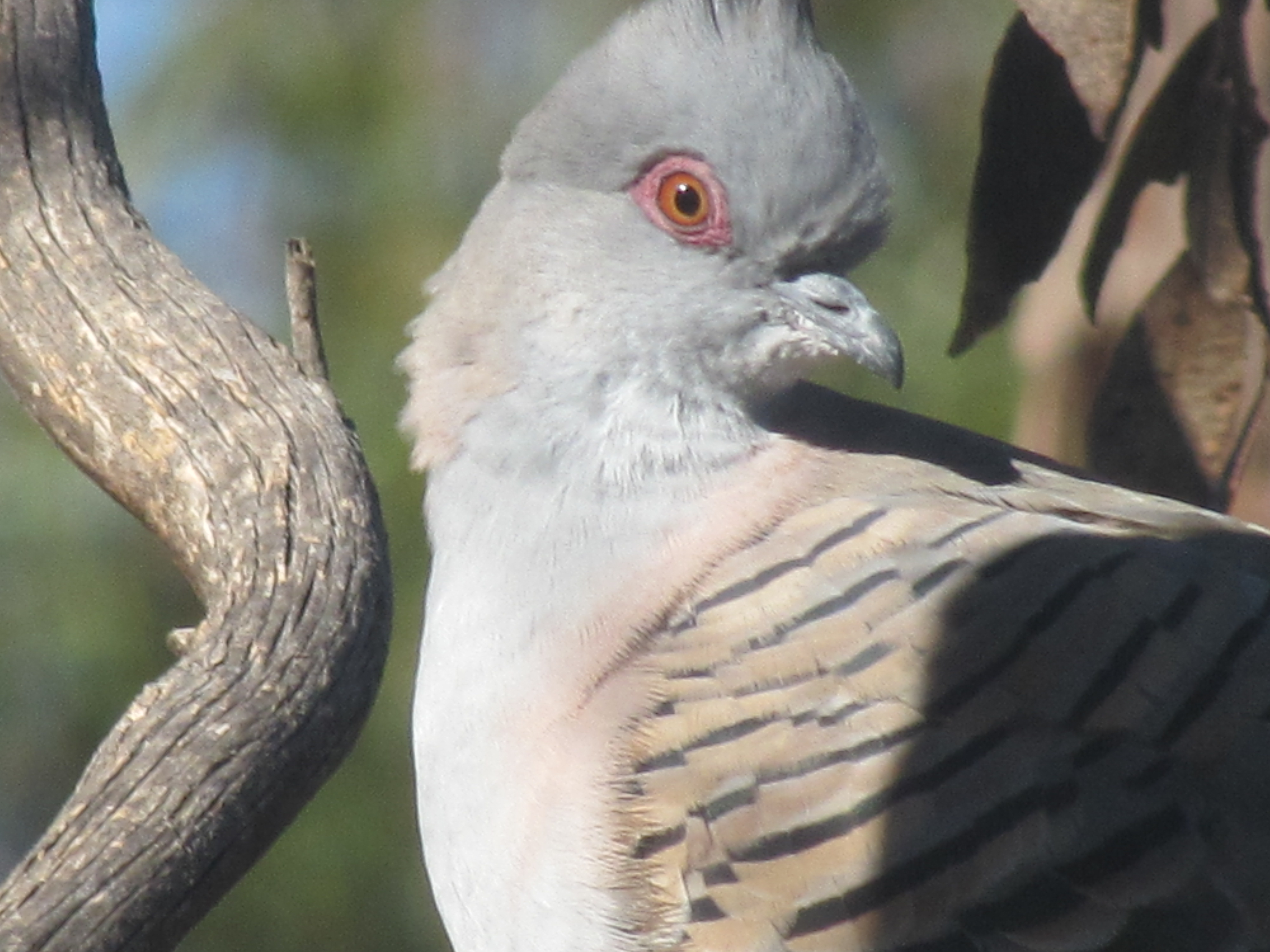
Crested Pigeon

Crested Pigeon
Hi I’m Anette.
Today I have found a 4-5 wks. old Creston Pigeon on the ground. Probably fallen from the nest.
The nest sits pretty high in a thin tree and it would be too dangerous for me, trying to put the pigeon back in its nest.
Has anyone an idea what to feed baby pigeons?
Hi there Anette. Try reaading through this article for help:
http://www.trevorsbirding.com/great-birding-moments-5-crested-pigeon
I also found a baby crested pigeon, i found it near the road, and it can’t fly yet. It is all gray with orange eyes. Im not sure how old it is.
I’ve had it for a few days, and i have not seen it eat anything. I have some canary bird mix, but i might try some other bird food too.
She (or he) is very chirpy and loves to perch on the stick in her cage (i used to have other birds).
She doesn’t mind me patting her under her beak, but not on her back. She flies a little only to the perching stick.
What should i do? What should i feed her?
Hi there Ania,
I am not at all experienced at looking after baby birds. Can I suggest that you ring your local pet shop and ask for advice from them. They should also be able to give you a contact name of someone in your local bird club who would be experienced in breeding and caring for birds. Sorry I cannot help.
Hey,
I have a baby pigeon and it’s probably only a week or so old and I have no idea what to feed it.
Can you give me some ideas on what to feed a baby piegon?
Thanks.
Hi I found a small crested pigeon on the road while walking my dog.She didn’t attempt to move but was perfectly fine to be picked up and snuggled into my neck and made a sweet sound , doesn’t appear to be injured I didn’t want to just leave it so home she came with me.she is in a basket with cozy lining .my Question is ‘ what do I do now ‘
Hi Louise,
I do not have any experience in caring for birds. Do you have a bird club nearby, or do you know someone who keeps birds for a hobby? Perhaps someone who has experience in caring for birds can help you. Another alternative is to contact your nearest vet or animal rescue group for advice.
I am not at all experienced at looking after baby pigeons. Please see my previous comment.
Deer Kylie I have found crested pigeon over year a go.She was foll out of nest.She is very happy.Only breeding time she make 2 to 3 egg’s 3 to 4 week’s seed on them.after live egg’s she always sad after 3 or 4 days than she is normal again.About 5 weeks a go again have 2 egg’s time pas she is getting upset more and more ,not eating much.I think best to remove them.when i did she is very upset and beets me 2 days pass still upset.I want you to help me please if you can.She needs have a partner.Male crested pigeon .Do you think you can help me.I want her to be happy . Thanks
Leyla, I have answered your email privately on this matter.
i have had many a crested pigeon, i feed all fleggling the granivour mixed with mealworms, a little insectivour. i provide a few pieces of fresh fruit and vegetables and also trill bird seed. always have fresh water near by. please dont hestitate to contact me over any thing. hope i have been helpful and not a hinderance
Thank you for those hints Kylie.
I am very eager to buy a crested pigeon i am from pune India
Intersting bird
Hi there aatish, welcome to my blog about wild Australian birds. This is not a site about keeping birds in captivity.
Crested Pigeons are sometimes kept in specialist aviaries such as in zoos but they are not easily obtained. I would be very surprised if you could buy one in India because I have never even seen one in a pet shop here in Australia.
I laughed at Karen’s experience mentioned above. My husband had a similar experience with 2 crested pigeons flying into his workshop and then flying to him and sitting on his head and shoulder. We think they were probably hand raised and either escaped or someone had let them go. They just looked for someone else to watch out for them and for food. Of course he had to bring them home and they happily went into a cage prepared for them. Now we are considering an aviary for them to live in. I already have a aviary of ringed necked doves but am unsure of putting them in with them as the doves are not as sociable as I thought, as they are quite mean to one another in mating time.
Hi there Andrea.
Crested Pigeons will breed readily in captivity but require a large – preferably planted – aviary to be really content. Seeing they were probably hand raised you might be able to get away with a smaller cage – I have no experience in keeping pigeons. (My interest is mainly in wild birds.)
One reference book I do have says that they can be very aggressive during breeding, even to birds much larger, so it is probably best to keep them away from the doves. Otherwise – it could all “end in tears.”
Check in your local library for books about keeping birds so you can get an idea of the best size aviary for them. Alternatively, check the phone book for the nearest bird club for advice.
I have seen a pair of crested pigeon in pune at jogs bird breeding centre in 2006 i am found of them
Something that should be considered if you’re keeping crested pigeons, or any other native birds, in a cage or aviary. Depending on what state you’re in, you may be breaking the law if you aren’t a registered carer or a member of a carer organisation.
Thanks for the reminder Steve.
What you say is a timely warning, though it is only partially correct. As far as I understand it, each state of Australia has its own regulations. Before keeping any native bird or animal one should check with the relevant authorities, often National Parks and Wildlife (check in your phone book).
There is a permit system for keeping native birds in captivity. In South Australia, for example, a few species may be kept without a permit. Other species may be kept with a permit and holdings must be reported annually. Some species may be kept for breeding and sale if you have the relevant permits. The caged bird trade is highly regulated in Australia – as it should be.
What is quite clear though is that you cannot take a bird from the wild and keep it as a pet unless you are a registered carer. This is the point that Steve is making.
Always check with your local WIRES or wildlife carer organisation for advice before keeping an injured bird or animal as a pet. Check in the phone book for contact numbers.
Just to add to what you said regarding carers organisations Trevor. Most don’t cost much to join and they provide training if you wish to become a carer. Some will even supply you with cages and other supplies.
So if someone has found an animal and wants to look after it themselves, it would be worthwhile joining a carer’s organisation. It’s very rewarding. Incidentally, I’m caring for a crested pigeon at the moment after getting a call from a local vet. I’ll try and get a picture of it on my carer’s blog http://possumpocket.blogspot.com this weekend.
Thanks for that extra advice Steve.
A few months back, during a fairly bad storm, a Crested Pigeon chick fell out of his nest and landed on the roof of my car. I thought I could see his nest, but there were no birds around being particularly concerned, and I couldn’t climb up to put him back.
I took him inside and had a helluva time trying to feed him. I’ve only reared mammals, so it was odd to me that his beak opened upwards. I was feeding him ground up ‘native bird’ seed mix that was softened with boiling water, cooled, and then fed to him.
I went to the big pet supplies store we have nearby and got the only thing I could find that any websites had told me I could use – layer pellets. I wasn’t sure if it was okay, but he seemed to love them. And it was much easier to push half a soggy pellet down his gob than mushed up seed.
Within a few days I was combining the tiniest bits of grass, fresh seed, and the sort to his food, and within about two or two-and-a-half weeks, he was feeding on his own. Hurrah!
I got him a much bigger cage, and set up a tray in the bottom that had grass and other seeds grown in it for him to romp and scratch around in. [I had three, alternating them being in his cage and being outside to recover, seeing as he loved to uproot the seedlings]
I kept his cage inside, but during the day I’d put him out to enjoy the sun and air, and I’d let him out when he was inside so that he could play on the ground or snuggle up with me, which he loved doing. Best neck warmer I’ve ever had. I can’t believe how incredibly playful he is, and intelligent too. If I tapped something with my finger, he’d come over to find out if I had food [handy if I dropped crumbs during a meal]. But if I did it too many times, and there was no food, he’d mock attack my hand.
And just as I was about to upgrade him to a new, bigger cage, he passed away. I uncovered him this morning, and he was huddled up in his nesting box looking sleepy. I came back an hour later, and he was on his side on the floor of the cage, dead.
Quite disturbing.
We suspect he had brain damage from the start, as he often was much clumsier than we thought he should be, and sometimes had trouble doing menial things.
I really hate to think I may have shortened his life somehow. Did I do anything wrong? I did a fair bit of research before I set him up.
Actually, here’s a peculiar video of him. If we had him on the table during dinner, he’d roll onto one side and flip a wing up. He looked like a sail boat, and the first time he did it, he had us in stitches. =D
http://www.youtube.com/watch?v=tWunLdnqBJU
I have just watched the video, and that behavior with the wings is quite normal, mine used to do that and he was well.
Sometimes if they aren’t fed the right stuff when they’re young it can affect their development, but it sounds like you fed this one properly Sarah. You gave him a bit of extra time that he wouldn’t otherwise have got.
The easiest way to check for brain damage in any animal, including humans, is to shine a light in its eyes. The pupil should contract, if it doesn’t then there’s a good chance its concussed. Usually they’ll get over it in a day or two, sometimes it takes a bit longer. Sometimes it’s permanent.
From watching that video, I’d say you’re right about the brain damage. They can be totally alert in some things and completely stupid in others.
I’ve actually just got back from picking up a concussed lorikeet not ten minutes ago. He’s downstairs in a cage at the moment unable to fly. Concussion is really common with lorikeets.
Hi there Sarah and Steve. Thanks for visiting and for relating your experiences.
Hi there,
I’d like to know where I could find some information about purchasing and raising a crested pigeon in Victoria, Australia (Melbourne).
Thanks in advance
Hi there Liz – sorry for the delay in replying to your question.
This is a blog about birds seen in the wild – not about keeping birds in captivity. There are many pet shops which have websites so you would be better off checking them out. You could also look in your phone directory for the nearest pet shop or bird club.
May I remind you that there are many restrictions on keeping Australian native birds in captivity and that most species require a special permit. In addition to that requirement, most species have very specific needs to be kept successfully in captivity, especially cage size, food, nesting requirements and so on. Crested Pigeons certainly fall into this category as far as I know.
I would suggest that you do your homework first. While it might be possible to buy and keep this species, expect to have a long search Australia wide, and be prepared to pay several hundred dollars for a breeding pair.
I have found a baby crested pigeon. I have no experience with birds but I spotted this one as a cat was playing with it in my back yard. It has not been harmed bu the cat, but I have no idea where its nest is located. I would like to care for it but as I feel that if nothing is done this bird will surely die. I am not sure what I should do. I believe they eat seeds, but what kind of seeds and that they need to drink every day, but how do I give it a drink (in bowl, in a something else) I need advice can someone help please. Thanks
Zoe
I found my crested pidgeon incredibly easy to care for.
If you have a small eyedropper [with a narrow opening] you’ll be able to encourage it to drink.
The biggest thing, if you’ve never cared for a bird, is to remember the UPPER part of its beak opens upward.
To open its beak, nestle the bird on your lap, cup your hand over it, and bring your index finger and thumb around beside it’s head. Cradle the back of it’s head in the webbing of thumb/finger. Use those two fingers to hold the bottom beak, and use a finger from your other hand to lift the tip up. Once it’s open a few milimeters, move your thumb and index a little so that they’re wedged between the upper and lower beak [Use the side of your thumb, finger, so you don’t crack the beak open too wide when it’s resisting]
Don’t overwater it, though, as baby birds only get water from their parents. They don’t drink that much.
Pick up some canary seed mix, and grind it down in a pestle and mortar, and then mix with warm water [make sure it’s cooled down a little before feeding, but not cold]. If you have a really narrow spoon, that’s your best bet. You can try sticking it in a syringe or eyedropper, but I found it didn’t work.
I ended up opening it’s mouth, taking a pinch of the seed mash, squishing it into the bird’s beak, and then using my fingers to run down the sides of the beak and helping the food further into the back of it’s beak.
Hope that helps you a bit.
I found that my pidge never called out for food. He very rarely made quiet little peeps. I took to feeding him small amounts every hour.
As far as bedding, I used an old icecream container, put shredded newspaper in it, and then covered it with tissues. I put a hot-water-bottle [warm, actually] underneath it, so that the nest was warm for him.
Hi there Frank – welcome to my bird blog. Thanks for stopping by and leaving some comments.
Thanks heaps Sarah – I’ve had a very busy day – you’ve stepped in and given an excellent answer to Frank’s questions. I really appreciate it.
Thanks Sarah I’ll do my best.
I won’t be able to feed it every hour as I work and can not take it to work. If I feed it morning and night will that be OK do you think?
I will stay in touch and hopefully I will come back with some good news.
Cheers Frank
Frank
I don’t mean to come across as being holier than though, but if you are not able to look after this bird properly, then find someone that can.
If you’re in Queensland, then you’re breaking the law if you’re keeping it without a permit. So many people think it’s cool to raise a baby bird and they rely on what ever knowledge they can glean from the internet to help them do it. If you don’t look after this little fellow properly it will die. Crested pidgeons are not hard to care for, as someone else said, you can get Wambaroo granivore mix from you local petshop and it’ll have instructions on the box so you know how to make the mix up.
What Sarah said is good advice, but get in touch with a wildlife organisation in your area. You’ll get much quicker, specific, advice which is what you need when you’re looking after animals that can be apparently healthy one minute and dead an hour later. I speak from experience.
What do you plan to do with the little guy when it grows up if you’re successful, you can’t keep it as a pet, so you need help with releasing it. Find a carer, they may be able to help you become one yourself, then you’ll discover just how rewarding, and hard, it can be.
You are “Holier than though” I took ours to the wildlife centre and the vet and both said to put it down. The bird is blind and cannot feed itself of fly more than a few feet. We have been hand feeding it for nearly two years now and it has travelled all over Queensland sitting on the back of the car seat. It is part of the family and I have no intention of handing it over to someone who is going to put it down.
Years ago we picked up a starving dingo pup near Kajabbi and called it Kajabbi. Every wildlife centre we took it to told us to ‘knock it on the head’. We had Kajabbi for years and there was no way we were going to knock a native on the head.
I was on the phone sitting outside this morning, when I felt something pecking at my toenails. I looked down and it was a small crested pigeon. By looking thru all the comments, I think it is beyond the baby stage, and now a fledgling. The next thing I know is that it flew up on my shoulder and spent a few hours with me. We wondered where the mother was, and, thinking that something must have happened to it, built a little nest in our sheltered BBQ area, and had to go out. When we got back, it was gone. We thought that it must have found mum and taken off. Half an hour later, it was back on my shoulder, and is now, happily, on my step daughters head, watching her play on the Playstation. I have never seen anything like this. I had a budgie once that I tried to tame and never succeeded. This bird is so tame!!!!! I do not want to cage it, but like that it has come and gone and come back again. I do hope it continues
Welcome to my blog about birds Denise. Thanks for stopping by and leaving your bizarre story. It must be really interesting to have been “adopted” by this bird.
I can’t help wondering if it is a wild bird, or a hand reared captive bird that has escaped. I suspect that it may be the latter – they are relatively common in aviaries.
Enjoy the experience.
I think it is too young for having been hand reared,,, it still looks quite small and has, what I think, are juvenile feathers on its head ( quite spindly looking). Is there any way that you can tell what sex it is?
Sorry – the sexes are the same. The only sure way is a DNA test at a vet – that would cost heaps. Oh – there is a simpler way – if it lays an egg….
Denise, where abouts are you? I’d love to come over and play with its crest. Sounds gorgeous! Are you feeding it?
We are in the Northern Suburbs of Sydney. My husband went out and bought some wild seed mix, which is proving a challenge to it, so I got some organic multigrain bread soaked with water and it is liking that. But it follows my daughter around the garden and pecks where she digs, so I guess it is at a stage where it can nearly feed itself
That’s very sweet. Sounds like it’s probably self sufficient at least so that’s a relief!
Looks like you got a little buddy to play with! hehe
Just an update on Gussy, our crested pigeon that flew in a couple of weeks ago. What an extraordinary bird! He is now the king of our household. He has his place to sleep ( on the back of one of the dining chairs) he follows me around the house, he plays on the computer (he loves tapping the mouse and has navigated me away from pages that I am on), and he watches TV on top of any head that will have him. As I am typing this, I am lying on the floor and he is having a little rest time watching. He still comes and goes as he pleases, and will often have the day out flying around the neighbourhood, but returns home before it gets dark. When he first arrived, he made quiet cheep cheep noises, but his voice appears to be breaking, and he is starting to do the woop woop noise and he has grown bigger. This suggests to me that he was a fledgling and is now becoming an adult. So it is anyones guess to how he became so tame …
Thanks for sharing your experiences again Denise. Your pet must be such great fun.
Hi, I came across this forum while trying to find out when & how to teach a crested pigeon, I have been looking after, to get used to being with her wild cousins. If she was with her parents still, I think she would be at the stage, where they would only feed her when she was realy hungry. She is fully fleged but still wants me to feed her. She is just starting to peck around for food, so I have put her in one of my cages during the day to get some flying practise & to learn to eat seed, but I still feed her. I only keep chooks & I have never hand raised a pigeon before. I live in the country, & we have plenty of trees around here but we also have hawks & eagles, I’m hoping the chooks can teach her about them, but would hate to have anything hapen to her. I wouldn’t like to keep her in a cage all her life ether. I’m hoping that I can put her in a cage, with a door open for her to come & go like the domestic pigeons do. If anyone can help please let me know.
Unfortunately our little Gussy did not come home one day and hasn’t been home since. I can only imagine that something happened to him, or due to his tameness, landed in someone elses house and they have put him in a cage. In response to Geraldine, I did notice that some other crested pigeons that live around our house were not very nice to Gussy. Perhaps they are territorial, so I would not expect yours to just go and join a family. But I think the cage door open sounds like a good idea…better than being locked up all its life and worth the risks… up to you though
Thanks Denise for your info. I’d like to ask one more question, do you know how long it takes before a fledgeling can be independent? e.g.; eat & drink on their own. Once she can do that, I can start letting her out of the big avery, & hope she will come back, to where it is safe for her.
I am not sure, Geraldine. The bird we had flew in and I think it was already a fledgeling. But it did also like to be fed. My husband ran off to the shops and got some wild seed mix, but that was too challenging for it. Canary or budgie food was the best.Sorry I cant help you further. Keep us posted to whats happening there
Good Luck
I found a crested pigeon only like 7 wks old it looked really cold so i took it home how do you feed it please send me another comment if you do know his becoming skinny !! thanks
Hi there Sharon, can I suggest that you read through all the comments above to get some ideas on how to care for the bird you rescued.
Hi every one, I’d like to give an update on the crested Pigeon I raised. We called her Cooey & I put in a closed chicken pen outside & stopped hand feeding her. I left her there with water & a wild bird seed mix for her to eat, till I could see she was eating on her own & would be OK. I then made an opening at the top of the cage with a platform for her to stand on & let her free. Her comes around every day to say hello to us & comes to get a feed but most of the time we don’t see her. We hope that when the time comes, that we don’t see her anymore, will be when she has started a family of her own. We can still go up to her & pat her & she will still sit on our shoulders.
Thanks for the update Geraldine.
me and my friend found a crested pigeon yesterday, and were not sure what to do with it. he/she is very quiet and lets you handle it. it walks into walls alot and cannot fly from what we gathered. what does it mean when if puffs up? Its not very young, but how can we determine the age? my friends are unsure what to feed him.
Sarah – thanks for the comments and your question. Please read through the comments above and see what other people have done.
Hi Sarah, I don’t know if I’ll be right with this, but I have had a lot of birds in my time. I think your pigion is very sick, birds feathers stay fluffed up when they are not well. It might have been attacted by something or it might have a disease. Try to keep it quiet & feed it chicken starter crumbles, if it looks to be the same size as an adult pigion. If it is smaller then an adult, you can buy a baby seed eating bird feed, from most pet shops.You will need to force feed it at first, if it is young, not much to start with & not to soon, see if it going to live first.
I have tried in the past to help an injured bird & it has often died from shock, it’s injurys or if it’s sick then from that. Good luck.
Sarah here again, um do you suggest i take the crested pigeon to the vet?
That would be up to you or you can just let nature do what she does. Sorry I can help you with that.
I have had 2 crested pigeons as pets.The first flew of one afternoon when I took him outside one day-he returned the next day.Every day after this,he was let outside and he would fly off & return in the evening.This went on for a couple of months until one night he was not his normal self & died.Possible poisoning from gardening chemicals?
The second one I found on the street sunning himself.He had a damaged wing and leg.He was a wild bird & did not want to be caught.After being caught, he settled down and made himself at home.The wing never healed to enable him to fly out of danger.
He realised that he was when he was outside when he was let out in the garden.At the first sign of danger he went straight to his cage.
Regretfully,I had to move and could not keep him.So,I took him Featherdale Wildlife Park in Sydney where I believe he will have a good life.
Crested pigeon update.
Hi there,
A few years ago I wrote and told you I had a crested pigeon walk up to me and I took her home. I still have her. She is even more affectionate than ever, although she hates my two boys with a passion. She will wait until they walk pass her and then either attack their feet from behind or land on their heads and give them a good pecking. (They both deserve it!) She lays eggs with regularity. Before she lays one she is fluffy and cuddly. Once the eggs are laid, watch out…particularly the cockateils & my boys. She is still very inquisitive and loves things that are shiny or brightly coloured (colouring pencils etc.). She is snuggled under my chin as I’m typing this, softly wooing and quivering!
Hey – thanks for the update Karen.
That’s awesome to hear, Karen. I remember when I had Pug [strange name, but they do have squished faces!], he’d snuggle up right under my jaw when I was lying in bed reading, and he’d quiver and click happily. He didn’t ‘woo!’ very much. He was, really, a teenage boy embarrased that his voice was breaking.
Haha. I remember when he first figured out how loud he could whoop at me, that he was strutting around the loungeroom for an hour with his chest puffed out, like he was king of the world. Every now and again his woo would turn into a squeek and he’d hide down in his feathers for a few seconds. 😛
Thanks for making me laugh Sarah. Most amusing.
I work at an animal park and we have the funniest crested pigeon. He views all of us as other males and tries to see us all off when we feed him. He runs so close to our feet that you have to be very careful not to step on him, and waits on the feed tray for when you stand up so he can hit you with his wing. I recently started wearing a head scarf which he hated and sat on my head attacking it, so that had to go. He may not be as friendly as the ones above but certainly has personality and makes him one of my favourite animals in the park!
Cooee, the crested pigeon I raise, is still coming around to get her free feed & cuddles from us, which makes us feel very privileged. The old saying about if you set some thing free & if they retune & that means they really love you, is so true.
The only problem is we are going to be moving & we are a bit worried about who will be living here when we are go. She knows our place as a safe place. We will just have to keep our fingers crossed that the new owners love birds as much as we do & don’t have cats.
We were also wondering if anyone knows how long a wild crested pigeon lives?
Sorry Geraldine I could find no reference in my library or on the internet for the longevity of Crested Pigeons. I would guess that they must live for quite a few years in the wild, perhaps 12-15 – but I am only guessing.
Thanks Trevor, I hope she can live a long live here even after we have left, she is such a loving bird.
Hi,
I never really noticed crested pigeons, until one day a couple turned up with a box and gave it to my mother with a clipped winged crested pigeon inside (didn’t know name of pigeon till recently) at first glance I wasn’t really struck with any special feeling, till two days later when he said his first “Woo” obviously wanting my attention, since then he was named “Woo” and lives outside in a large cage during the day threatening the chooks with dire consequences and coming in during the night to sty safe from snakes and “Woo” at us to his hearts content. Twice now he has told me when snakes were in the room, once in pitch blackness, and was very sweet after both times when I caught and removed the snakes. I’m now looking for a girl “Woo” for him and take possitive delight in pretending his crest is a straw.
Hi Trevor,
I wrote to you a couple of years ago, about my white crested pigeon. I still have him, & his parents have hatched 5 more white babies since. I have been lucky to save 2 of these from the nest. The others unfortunately were taken by predators (rats, other birds). My 3 white birds have all been hand raised, and live safely with me in the house, where we have 3 large parrot cages. They are all pure white, and would have been killed by other birds if left in the wild. They are so affectionate and have become perfect pets. They each answer to their names, and fly to me when called. My partner, poodle dog & the pigeons all sit & watch TV from the couch at night. We love them.
nawwww i love hearing everyone’s stories about there crested pigeons 🙂 im 15 and have found this page while looking for information on the bird. Tonight my cat scared a crested pigeon into the house and so i caught it. I put it into an old cage i had (about 1 meter by .05 meter) and added a flat plate of water, sticks, and wild bird seed. i would love to keep it, but i know it should go back into the wild. I am wondering if it will still be content and healthy living as a pet, or because it is a wild bird that it should go back to its natural habitat?
Hi Gabi, I think you should let it go, it was born & grew up wild & would not adjust to captivity well. If it had been had hand raised, then it wouldn’t know any difference, but it wasn’t & if it’s not injured then it should be free.
The crested pigeon we raised, we named Cooee & I set her free in stagers, once I knew she could fly & eat by herself. She is now a totally independent wild bird, but still comes to visit us now & then. She still recognises us as family but when I take some seed out to her as a treat, (I do spoil her a bit) she attacks my hand as I pour it out, as though I’m another bird steeling her food. We think she has had a family in the last few months, but we don’t know if there are any young ones with her, though she does fly with other pigeons, & they might be her family?
It was hard to let her free, knowing all the dangers out there & one extra for her, as she now trusted humans & not all humans, would try not to hurt a bird like Cooee. She is still out there & we supplement her feed because us humans have reduce their feed supply & added a few more predators to their world.
Thanks for your comments Gabi – and for Geraldine for answering.
Hi Trevor
Remember me? I’m the magpie guy from Kingaroy (and I’ll send an update to that page) but I just wanted to tell that we must have done something good somewhere, as in addition to the magpies, we now have a pair of crested pigeons nest-building in a shrub just three metres from our front door. Seems like we’re being taken over, but are looking forward to watching and learning about their child-rearing.
Cheers
Clem
That’s great news Clem. Keep up the good work – and enjoy the new additions to your “family” as they hatch.
[…] Crested pigeons as pet birds (66) […]
I love reading the stories about the crested pigeons. I feed a number of them in my Brisbane back yard. Can anyone tell me how to tell the difference between a female bird and a male bird? I have one particular bird which often comes on his own and will now fly to me when I call him and I then throw seed to him. Most of the others are more cautious.
I found this site looking for info on crested pigeons as friend found one apparently fallen from nest or abandoned. As they were going on holidays they didn’t want to leave it outside for a cat to get! It is about 10cm long and still has the little thing on its beak for pecking out of the shell (don’t know the name). Any ideas on what to feed it?? We have been having some success feeding commercial chicken crumbles (dry and also made into a paste), but is not overly interested. Also don’t know how much they would need. Any help appreciated!
Hi Caroline,
I’ve raised a crested pigeon, I got advice from a wildlife park & it was good advice, our Cooee, as we named her/him, think it a him, is now a healthy year old.
You can get some baby bird food, for seed eating birds, from a pet shop. You need to make it the constancy of porridge & feed it with a babies bottle, & you need to cut a hole in the teat, to make it bigger.
This is how crested pigeons are fed by their parents, the baby birds, put their beaks into the mothers beak & then suck out the food as mum brings it up, all ready pre-digested, so your baby has to be able to put it’s beak, into the teat of the bottle, to suck it out. You just let it keep sucking, till it has had enough.
Both parents look after the young.
You need to do this at least 5 or 6 times a day, it will let you know when it’s hungry but keep it somewhere, where you can see it & it can see you.
Here is a youtube video we put on of our baby all grown up & free.
We think she’s have 3 batches of babies of her own now.
http://www.youtube.com/watch?v=Cd8zmfgtRYo
Thank you so much Geraldine. I rang WIRES and we got some parrot rearing formula and your info about feeding, your video and others found on youtube will be very helpful. Thanks!
Your welcome Caroline, hope your little crested pigeon grows into the beautiful & healthy bird. Nice to see someone who cares about natures creatures.
Hi Karen,
Just recently I had the exact same experience as you described. I was very surprised by the details coinciding.
I also kept the pigeon and he/she is really the most wonderful pet.
I would like to get in touch with yourself or someone who cares for Crested Pigeons.
Kind regards, Edith
Hi, I had a crested pigeon as a pet. He fell from his nest when he was little and I raised him. But he got a respiratory infection and died on Saturday just as I was putting him in the car to take him to the vet. I really miss him and am looking for a new crested pigeon to love and look after. If anybody has one and they can no longer care for it please let me know or if anybody knows where I can get one please email me. My pigeon was my pride and joy. He showered with me, slept on the end of my bed and I just want another one. My email address is greatape@virginbroadband.com.au. I hope to hear from someone.
Dear Caroline,
I was just reading that your friend found an abandoned pigeon. I am wondering if they plan on keeping the little bird. I found one 4 years ago and hand raised it and it became my pride and joy. But he got a respiratory infection Thursday night and died before I could get him to the vet. I am trying to find another crested pigeon to love and care for so I am asking if your friend is planning on keeping the little bird or would you consider giving it to someone else to raise and love.
April, I’m so sorry to hear about the loss of your pigeon.
The one my friend found is going well and his kids are quiet attached to it, so no luck there sorry.
I hope you find a bird that can benefit from your obvious care and love.
Regards, Caroline
Hi Caroline,
Thankyou very much for replying. They will get alot of enjoyment out of him/her. I hope I find another soon as I miss him so much but we will see what happens. I will let you know if I am successful.
Does anyone here feel that it’s a terrible shame, that the crested pigeons & other wild birds that we raise, can’t be let free in the knowledge that they have a good chance of survival in the wild.
I’m not talking about integrating with other native birds & animals, like any other wild bird has to deal with, but the risks of dieing from garden poisons, cats, or the fact that we, as humans, have taken most of their feed growing areas away from them.
We have been lucky with our Cooee, as there aren’t many houses around us, & we feed her, so she doesn’t need to go far for food. She is now bringing one of her babies here to feed along with all the other wild birds we feed.
It is so nice to know that she has had at least one baby that has survived, out of the 3 nests of babies that we think she has had.
We think we have worked out why she started to attack us when we fed her.
I was reading Aimee’s account in an earlier post, (she works in an animal park), of a crested pigeon who attacked avery one who fed it.
Our Cooee does the same thing. (We call Cooee a girl, because the info we got when we found her, led us to think, it was a girl but now we believe Cooee is a boy, but we still say her).
We noticed that she stated to show this behaviour after the first time that we thought she nested. We finally realised, that it is was a natural instinct of the parent bird, once their young were ready to look after themselves, which was about the time it started.
She started to do this, when she would have been weening her babies. I’m not sure what she sees us as, but between nestings, she seems to want more contact with us.
I think we fulfil all the different element of a crested pigeon family. We feel very privileged.
Hi, was wondering if there are crested pigeon breeders out there. I’d like to get a mate for my crested pigeon. It’s quite funny though, at the moment he thinks I’m his “mate” and e\if he feels ignored he makes catching him VERY hard and won’t talk to me. A few weeks ago another pigeon turned up (not a crested pigeon, someones pet pigeon) he hung around because he fell in love with Woo but Woo HATES him and every time I pay attention to the new pigeon Woo gets mad! and won’t forgive me till I give him a kiss and a cuddle. I would like to own crested pigeons for the rest of my life, so knowing a breeder would be very helpful.
Thanx.
Hi Aleisa,
There are no crested pigeon breeders that I am aware of. I have rung so many people since my pigeon died cause I want the joy of owning another one but everyone I speak to says they are illegal to sell cause they are native birds. I dont understand how they can sell cockatoos etc but they can not sell crested pigeons. Especially since so many of us love them so much and wish we had more. Or in my case another one. If you do have any luck let me know cause I would pay alot for another crested pigeon. I wish i had found this site before my pigeon died as we may have been able to breed them ourselves knowing that their chicks would be free from predators. Good luck. And if you ever find a friend for your pigeon and they successfully breed would you let me know. I would happily buy another crested pigeon. My email address is listed above in a previous comment.
Cheers April
When we move to Tassy I hope the new owners of our place love birds & will look after our Cooee. Sure hope they don’t have a cat.
Hi Geraldine,
Why dont you take Cooee with you. When my pigeon Foz was alive he was always an inside bird. But we moved twice. At boths houses he decided to go for a fly and both times he came back to the right house. Maybe if you can take Cooee with you and let him settle he may make a new home in Tassy with you. I’m sure he will miss you just as much as you miss him/her. I am currently raising a baby swan and I am hoping it will come back each year to visit. I’m hoping if I move the people who live here will let me know if he comes back and I will introduce him to my new house and see if he will come visit me there each year. We’ll see. Good luck with Cooee. I hope the new owners are good to him/her too.
Hi April, I don’t think I would be legally able to take her to Tassy. As far as I know there are no crested pigeons in Tassy anyway & I think as it is illegal to keep them without a permit, so I wouldn’t be able to take her.
The other thing is, she is now use to being free, so I wouldn’t think she would like it in a cage again.
I just have to keep my fingers crossed that she will be OK when we go.
Thanks for your good luck wish.
Dear Trevor
My name is Edith. One day, as I was doing my early morning run, a crested pigeon flew right in front of me on the footpath, and started walking towards me. I bent down, talked to him, and I was thinking, the bird must be hungry. He came unusually close to me, I was able to touch his beak. I had nothing to offer, and regretfully continued my run. The bird followed me, flew up, and again, landed in front of me. I kept running. Then, about 100m distance from the very spot where met, I have seen, as the bird makes a big circle, and landing in front of me for the third time. Then I decided, I will catch him. It was peculiar to see as he followed me. He must be asking for food. It was easy to catch him. I did not continue my run, I have turned right back home. On the first day we kept him in a large cage, but since than, the pigeon walking/flying free in our house, eat with us, shower with us, run after us. He learnt to walk up the stairs, as he follows us everywhere in the house. He is sitting on one of us shoulder, sleeping on our knee, wooing all the time to us. He is walking on my keyboard, as I’m writing this email. I can move large objects around him, like food processor, broom, etc. He has no fear at all!! I can’t let him go to the wild, because of this. He would be perished pretty soon over there. There are butcher birds, cats, dogs, chemicals in gardens, etc. He let everybody too close to himself. I was hoping, that Karen, who has similar experience with her crested pigeon, will contact me. I am looking for someone, who can foster my bird, as I am planning to travel.
At least I need advice, about this matter.
I don’t know, who should I turn to.
I asked Karen to get in touch, (Monday February 22) but there is no reply.
Kind regards, Edith
Hi Edith,
Just a question, where are you located? Depending on areas, and if Karen is unable to get to you but I am, I would be interested too. I sorely miss my pigeon.
Cheers,
Sarah.
Hi all
Just be aware that in NSW you need a permit (with training) to keep native animals. Joining WIRES will allow that, and give you experience and training in rescuing/caring for all animals…or you can put your name down for care of crested pigeons only.
Cheers and good luck everyone – they are beautiful birds – but better off wild and free, and with their own flock.
Helen
Hi Edith,
I too am intersted in looking after your bird while you are away. If those who have offered are too far away. My email address is in an earlier msg that I had posted. So feel free to contact me if you have no other options. And Helen, after raising a bird from a chick the hardest thing to do is to let them free but most of us have done that only to find our pigeons come back. They feel safe with us they know where to find food and water and shelter. So if they chose to keep returning most of us will continue to care for them that why we took the time to nurse them and feed them to good health and adult hood in the first place. As someone has said before let them free and if they love you they will return and most do can we give them our love and they give it back. I have considered joining wires but my heart would break everytime i set an animal free cause I would never know if they survived. And I’m not sure if i could watch so many die. My animals mean everything to me.
Hi Sarah
I live in Sydney. I don’t know where do you live. I would like to contact you.I hope that I can do it with the help of Trevor. If you will give him your email address and he will pass it to me. I don’t know how it works to get to know each other addresses.I think that Trevor is travelling quite often so let’s hope he will read my message soon.—–So far I was emailing to April but there is no reply yet. Only you and April are who is interested about my problem. I can’t let my crested pigeon back to the wild because he is totally fearless he let everybody close to him. Because he was a baby when he met me he has no experience out in the wild. If I let him go it means I will kill him.
Cheers
Edith
Hi Trevor
I try to contact Sarah because she asked me where I live. I hope that you have her email address. Can you contact her? Can you tell her that I would like to write her? If she approves to give me her email address? I’m looking for someone who can foster my young crested pigeon during my holiday.
So far April were interested but there is no replay yet( I emailed her) and Sarah who’s email address I don’t know.
regards
Edith
Hi Edith,
I’m not sure how Trevor will be able to contact you, so I’ll just post my email address up on here. You can contact me at callan.sarah@hotmail.com
Cheers,
Sarah.
Hi guys i really need some advise, i have noticed a crested pigeon on the side of the road last week. i went passed today and it was still there. knowing the parents can feed their young i didnt know what to do, i took a look at it and all the rear feathers are missing apart from one. i assumed this was not normal and i now have it at home. i dont know what to do im more than happy to care for this bird i love birds all animals infact. i will care for it well but i think it might be young, but what about the feathers????Please could someone reply asap cos i dont know if i should just put it back.
If it’s lasted a week, I daresay it’s been looked after to some extent. Have another walk past where you found it and see if you can spot any pigeons hanging around in the trees.
As far as the feathers go, they’ll grow back in their own time. If you do end up keeping the little tweeter, I would suggest giving it a bath in slightly warm water to clean off any muck and make sure the skin isn’t damaged where the feathers ripped out.
Don’t use any soaps or shampoos that aren’t designed for birds. Most mess should come off with warm water. Strongly consider getting a bird de-lice spray, too.
Hi Natalie, I have left a post on how to look after a young crested pigeon in an earlier post. Please read post number 20 regarding feeding.
The feathers that are missing could be anyones guess, but most likely it’s a young bird that hasn’t grown a tail yet & can’t fly. If it is an injured wild adult bird, (it would have flown away if it could), then you need to feed it seed & have water for it, till it gets better & can fly again.
If it’s a baby, I don’t think you’ll be able to take it back to where you found it now. I know that some wild birds wont touch their young if they can smell humans on them. I don’t think missing tail feathers would stop it from flying either.
One time my husband was patting Cooee & he was running his fingers down her tail, he had her tail between his fingers when she decided to take of, to my husbands surprise, her tail feathers came out. He said he wasn’t holding them tight & they came out so easy. We had a guess that, they can come out easy, in case they are grabbed by the tail by a predator. She had no trouble flying after that & soon grew new feathers back.
Hope this helped
Hi Geraldine.
Thank you so much, i have had a better look over the bird i dont think he is as young as i originally thought. He has a whole through his wing and the last feather feel off him. he is very alert and he seems to be eating well.He does however move his head continuously from side to side even when sleeping is this normal???
Hi Natalie, it sound as though it could have been shot. It might have some other injuries you can’t see, & that could explain the head moving from side to side. I breed Polish chook/chickens & they sometimes get head injuries & will do the same thing.
You might want to take it to a vet to check it out or you can just look after it & see if it get’s well enough to fly.
If he doesnt get well enough to fly is it ok for me to take care of him?? if it takes months for him to fly is it still ok to let him go???
I just want to thank you for the advise u have given as i have been so concerned with doing the wrong thing.
Hi Natalie, if it can’t fly then it would need to have someone to take care of it, but if it gets well enough to fly, then it would be happier free. I don’t know how safe it would be free but just as us humans, its the quality of life not quantity.
Anyway, it may come back to visit you, if it grows to trust you & you left food out for it.
There would be no better feeling for me and him than to have him fly away.Im not one for caged animals to be honest. Im in an area where we have alot of turtles and for ever taking them off the road and walking them down to lake. Thats how i came across this bird (the same road). thank you again.
What a treat to find this site. I have a crested pigeon as well that my son found in the back yard one really windy day. It was only young as it still went tweet tweet. I had no idea what to feed it but guessed that baby bird food mashed up like porridge wouldn’t hurt it. as it was it loved it.My daughter has named it plum, we have no idea wheather it is a girl or a boy but it doesn’t matter as we love him/her very much. we say he because he is very naughty and cheeky just like most boys. he is about 8 months old now and has the run of our house. he only goes in a cage at night.I have been reading about how people let their pigeons out of a day and they come home at night and I would love to do that with Plum, but I own a cat and every second neighbour round here seems to own one too, so it is just not possible.He seems to be quite happy here though and is soooo lovable. we will have to see how things go. I do hope they live a long life as I would be lost without him. he is cleaning himself at the moment and wooping contently siting on my chest, loves his back rubs too, he wouldn’t get that in the wild.
Just an update on the bird i found. He is eating great his feathers are growing rapidly. He is a bit hard to work with at times, he seems to have retained alot of his wild behaviour which is great.
Now im just waiting for his feathers to grow completely then ill see how well he flys. He has stoped moving his head from side to side continously, his wing is healed but with a scar his behaviour now seems very normal.
Hi sarah
For some reason i didnt get to read your message till now. I still have the bird but i havent treated it for lice, i did see something on it the other day. Im abit worried now. i cant believe i didnt see you message sooner thank you for your advise 🙂
Hello! I currently have a baby (aprox 2months) old that I have been handrearing since the cat brought it in as a fledgling. I have raised many Doves & pigeons before with most being released back into the wild (except one pigeon who adopted us many yrs ago & lived for like 8yrs! But that is another story!!) anyways I have never had a Crested Pigeon before. I’m having trouble adjusting it from egg & biscuit mix to seed… any suggestions? This little one’s personality has totally changed in the last few days & I’m wondering if it has something to do with needing seed now or something else food related? Up until yesterday it was such a crazy, hyper little thing & now very lethargic & doesn’t do much other then sleep 🙁
Thoughts…?
PS- I also currently have a normal ‘Turtle Dove’ living in our bathroom which I’ve had now for 6months since it was little. Found it in the middle of the road one day while driving, so took it home. It seemed a bit hurt and I would say was on the road for a long time as it was the middle of the day and it didn’t even move or care when I picked it up. Once I offered it water it was VERY thirsty! His/her wing was damaged and she had a head graze which unfortunatly as she/he’s healed has caused it to lose it’s eye so we can’t release it back into the wild as predator’s could sneak up too easily! But it’s happy living in our bathroom (can’t let it loose in the house as our house is too open & we have cats) currently as it always gets attention whenever someone goes in and now that it’s winter it has the bathroom heater so much warmer then being stuck out in a tree!
hello Ali
that doesn’t sound good about your pigeon.i have one that i got fairly young and had no trouble weaning it off the mix. yours might be to young to be eating seed yet though, but i found with my pigeon if i put the seed on a towel it found it easier to pick it up they can get the seed deeper into their mouths that way until they learn to peck properly. i would give that a go and i hope he/she comes good soon.
Thanks Jane. The little guy was starting to pick at seed but we kept the Egg & biscuit going as well. Still are but he doesn’t seem interested in either. Not even if I tap seed on the floor, in a dish, on a towel. He has no energy and just sleeps all day. I don’t think he’ll make it but fingers crossed and at least we tried rather then letting him find for his own!
Ali
I’m hoping your little fellow is still alive because i have an idea that might get him to eat. I use a syrup called incremin it’s used for children when they lose their appetites and is quite safe to use in animals and birds i have had quite a bit of success with it with both my animals and birds. if you mix about half a teaspoon of syrup with about 30 ml of water and hold it under its beak dipping its beak into the water to encourage it to drink and do that every hour or so , even if it only has a little bit it might help, it has iron in it which gives them energy as well. its worth a try anyway.
Thanks Jane that’s so kind of you but unfortunatly Notty has since died. But I still have ‘Little Fella’ going strong! Thought I would share a couple of photos I have of them for those that might be interested….
http://www.flickr.com/photos/50716985@N08/sets/72157624164346156/
At least we gave Notty a chance. Hope everyone else’s birds are going strong!
hi Ali
So sorry to hear that Notty died,thats a shame they are such lovely birds with great little personalities. hope your other birds stay healthy. Just keep in mind the incremin if ever one of your other birds ever get sick it really does work. i would be so upset if I lost my crested pigeon. his name is plum and he is such a character.
i wanted to buy a pair of crested pigeons.wht is price ?plz tell me.my email is wajhat_ali@hotmail.com
Hi there Wajhat,
This site is about Australian birds I see in the natural environment. You need to search for a site that sells pet birds. I do not sell birds.
my family and i have found a crested pigeon and its parents are nesting in one of the tree’s outside our house.
We are not sure how old the bird is or what its sex is but it is making a squarking noise alot of the time we feed it and it still does it after it has been nursed and played with and sometimes it still does it.
I really love this bird but i am not sure if i should keep it as a pet or i should let it go it still has to be hand fed and all of the other birds and its parents have rejected it so if anyone has any ideas on if i should keep it or not plz let me know!
it can not fly it attempts (half) and fails.
thanx!
Im soooo sad the crested pigeon we found (jackie) died last night we are not sure what it was from
R.I.P jackie
Baby crested pigeons get cold very quickly, so they need to be kept warm all the time. I have a crested pigeon that was blown out of his nest when he was a baby and I used to put two hot water bottles each side of him at night and reheat them during the night. He is now nearly one now and as cheeky as anything. He comes outside with me and has had the opportunity to fly away but has chosen to stay with us. He loves to snuggle and sit on my lap just like a lap dog and can be very naughty at times, but he is a great pet. I let him make up his mind if he wanted to stay or go. I’m sorry that jackie died, its very sad when you try so hard to save them.
Well my pigeon finally decided to fly the coop 2 days ago after living with us for a year. I feel so sad, and miss him terribly. I thought that he might come back to visit, but he hasn’t. Iv’e been reading about other peoples pigeons coming home to visit and wander why mine hasn’t. He was very loving and loved his cuddles. It makes me wander if something has happened to him. I hope not. I’m hoping he has found a partner and is making a family together.
l have crested pigeons i n my house and they are very very strong
Hi,
I found a baby crested pigeon in my pool this morning, called the vet & they didnt sound too concerned so I would like to care for him, can anyone point me in the right direction where I can find the information Ill need on feeding ect’
Also will I need to give him water with a dropper?
If i put him back outside I thought his Mum might come and get him but I dont see how she would get him back in the nest & Im scared a bigger bird will eat him/her.
Thanks in advance for any replies he seems so sweet xx
i just got a dish and mixed up some baby bird egg mix which you can get from the pet shop. mix it up fairly sloppy then stick its beak into the food and it should start to feed. you will have to do that several times a day. it will get the idea of what it has to do and will start to feed itself in time. just do the same with the water as well.
Hi, Our dog just picked up a baby crested pigeon from some long grass next to our daily walking track. It cannot fly and has mostly down around its neck he looks pretty alert and not injured. I called WIRES however they are shut until 9 am. I have taken the heat mat from under my home brew kit to keep the shoe box warm however how do i feed this little chap until i can contact WIRES. I don’t have an eye dropper i was thinking honey and water or weetbix honey and water???
Thanks Dan.
sorry Dan havent been on computer for awhile, so only just got your letter. do you still have the bird? If so you need to get a babys bottle with the teat and cut the top off the teat so there is a big enough hole for him to put his beak through. you then put some baby bird egg mix which you buy dry from the pet shop. mix it so it is fairly sloppy. Put that in the bottle and put the bottle on its side and put the birds beak in through the hole. it should start feeding,just make sure it doesnt take in to much at once.
Thanks for your helpful suggestions, Jane.
Thanks trev,
It concerns me though that people think that honey is the best thing that you can feed birds, but it is actually the worst thing you can feed them in most cases. I am no expert when it comes to birds but i did learn that one from someone who is, and crested pigeons are very easy to look after if you know how.
Hi Jane – you are correct. Honey is certainly not suitable to feed to birds when you are caring for them. Perhaps I should write an article about that.
Hi Trev
Yes that would be a good idea. Make people aware of the dangers of feeding birds honey. I have known so many people who have reached for the honey jar to feed wild birds it’s not funny.
Hi Trevor, I just found a crested pigeon sitting outside. I went out to see if it was injured and it came over to me, followed me inside and has since been following me all around the house. It appears to be able to fly, and doesn’t seem injured. It has really bright orange eyes so I’m thinking it may be older? I rang the wildlife carer and they are not interested and the vet isn’t interested either. I don’t want to put him back outside in case the neighbours cats get him, but I have no idea what to do with him? If I keep him, how big does the cage need to be and what should I be feeding him? Please help! Thanks
hi michelle
sounds like your bird was owned by some one before. I used to feed my pigeon budgie seed and clover and grass seed from the garden. he also loved cracker biscuits crushed up. they generally don’t like being caged. mine used to go in a bird cage at night and I would let him out in the morning, unfortunately he flew away one day, so if you live on the Central Coast in NSW you may well have my bird living with you. He was very tame and loving as well.
Hi, I have just found a crested pigeon in the garden outside, and couldnt not see any other pigeons around or a nest. i would say that it is very young n has possibly fallen out of the nest as its been pretty windy today. I have brought him/her inside as it is very cold outside and was worried that he might die from the cold or cats in the area. I have read all about what to feed them and how to look after them but was wondering if there is anything i can feed him tonight that would be in the cupboard so he doesnt get hungry. He tries to fly but is unsuccessful and is just giving out very little cheeps but is very content to sit on my lap n snuggle into me. Any ideas would help a great deal, at least until i can get to the pet shop tomorrow thanks.
hi there,,, I had the same problem and i mixed some weetbix with water which made a very mushy mix…. try that
hi i have gone up to my avairy this morning whihc houses 30 odd finches, a galah and a ferret. they are all my pets but this morning was different, theres a crested pigeon sitting on one of the perches. i dont know how he got there or why. i generally get a few of them in my backyard that sit with my free range ducks and geese but am rather puzzled about this little guy. he doesnt seem to be a juvinille and is rather friendly but a tad spooked by all the commotion. will he make his own way to the available seed and water or will i need to help him? he seems quite parched. also are my other birds safe? inparticular my new fledgings (theres a gorgeous little piedface which is the only one out of them all)
Hi i am after some advice desperately. We found a baby crested pigeon yesterday in our front yard hiding behind a fence post as my dog was trying to attack it. I brought him inside with every intention of releasing him again but have seen since that he is a terrible flier. He doesn’t get much height at all and doesn’t go very far so now I’m not sure what to do. I have tried to get him to eat some mushed up weetbix and water mix but he wasn’t interested. Tried giving him water but doesn’t want it. I even tried blending up seed and water and still nothing. He pecks at his seed i have laid out for him in his cage every now and then but isn’t eating it. I have not seen him attempt to drink water either. Please i need to no what i can do to help this little guy. He is starting to sleep more and more and has diarrhea. I can’t let him go as he can’t fly well enough. Please help.
Here is a picture of him
http://img641.imageshack.us/i/babypigeon.jpg/
Hi Kerry,
I don’t have any experience at looking after orphaned birds. Can I suggest that you read through the comments above because many of my readers have had similar problems. Try following their advice.
Hi Kerry,
perhaps you should get him to the vet asap before they close they can arrange for a wires carer to look after him.
Where abouts are you? If in Bris I know of a local pet shop owner who takes care of injured birds, she guided me through raising a baby crested pigeon.
Are you trying to feed it with a spoon or a syringe??
Thanks for your help, Renee. Hope Kerry gets this update soon.
Thanks Trevor and Renee,
I called the vet and they told me to go out there so they could give me some special formula and syringes to feed the bird. They said that there is only one wild life carer here and at the moment and she has her hands full but if i needed to call her for advice to go ahead. They just said to give him this formula until he learns to fly a little better then to let him go. So i guess that’s all i can do. He is doing fine at the moment and no longer has diarrhea. I was worried about how much he was eating but the vet informed that his little stomach was only the size of half your little finger nail so considering that i think now his eating has been fine.
Thank you for your fast replies i greatly appreciate it.
Kerry
I’m glad your little one has improved Kerry. We have raised 2 much smaller than yours. Initially stressed, they were also slow to feed. Then they would take about a 2ml syringe of formula about 6 times a day, plus we would tap at the seed with our finger, pushing the seed about, to encourage them to pick at it.
To encourage them to strengthen their wings and fly, we would perch them on our finger, lift them up and drop our hand (slowly at first) and this would stimulate them to open their wings and flap. Good luck.
Hello, could someone please help me. I just found a baby crested pigeon sitting right at the back door. We have a nest high up in the tree, and somehow the baby fell out. I think this one is too small to get back up. We have a family of crested pigeons that live in the back yard and im sure the mum will want it back – tihng is I think it will need pigeon milk. Does anyone know what I can feed it until I figure out if I should call wires or try to get it back outside for the mum to find it.
Hello Lisa,
If you go up to comment no. 19 you will find what I have written there to Dan. it will explain what to feed it and how,if you cannot get your hands on a babys bottle, you can put the egg biscuit mix in a bowl but have to make sure that it is running, then just stick the birds beak into the mix and it will start to eat.you can try putting it somewhere where the mother can find it, but make sure it is safe from cats and the like, but there is no guarantee that the mother will come back and get it. good luck and I hope the little fellow survives. By the way they make great pets, very loving birds.
I have found a crested pigeon in the middle of the road tonight. It can fly but not for long, it’s wings and legs all appear ok. It just seems to have trouble holding itself up, a bit top heavy. It has been sleeping on and off in a basket for a couple of hours. It has not eaten/drank. Any ideas on what’s wrong with it?
Hello,
I found a baby crested pigeon in my backyard last night. I can’t see any nests around so I an not sure where he has come from but he looks fine he is fledging on my finger and doesn’t try to fly. He sits with me and doesn’t squawk or make any noises. I have tried feeding him but he doesn’t seem to want any. He is so quiet but he must be hungry? What should I do?
Thank you
Hi Nicole,
Thanks for your comments and question. Please read through the comments already made above on how to care for this little bird.
Currently have a crested pigeon we’ve adopted when found at a very young age. Fed it with the dripper and all that and im guessing is of about 4 -6 months of age now, so eats seed and all that. I am soon to pass it on to someone I know who keeps chooks and pigeons, we were thinking it might do better with the chooks as it might have a hard time fitting in the with the fantail pigeons or homers. Its gunna be difficult parting ways with the little critter as it has such an inquisitive temperament and almost acts like a dog in the morning coming to wake us up. What im wondering is if theres anyone round that keeps these things where I might be able to find it another crested associate to give it some backup so to speak. any thoughts? current house arrangement isnt such that we can keep it longer, unless we cage it (in a tiny indoor cage), which im not willing to do.
If you still have pigeon and live on the Central Coast NSW, I would be interested in taking him, I have chooks and have raised a crested pigoen before and love them dearly.
Hi Anthony, sorry I havent been on the computer for awhile. I dont suppose you have your pigeon still, but if you do still have him I would gladly take him. just write me if you still have him. Jane.
To Jane: Hi. Our cat decided to drag in a Crested Pigoen earlier today. Thankfully, the cat isn’t a very good hunter and had not caused the pigeon any harm.
We live on the Central Coast and were wondering of you are still interested in them. We cannot keep him (her?).
I have a Crested Pigeon who lives, with his wife, in my backyard. He’s rather fat (mostly due to the neighbours and I constantly feeding it) and incredibly smart. If it knows I’m home it’ll call out and literally sit by my bedroom window and look in (how it knows it’s my room I don’t know)! and responds when I say “come” and point somewhere. It also seems to know when I come and go from work and will sit there waiting for food (haha creepy)
It’s landed on my hand ONCE and has (unsuccessfully)tried to land on my head and face numerous times.
What I was wondering was, how can you tell how old they are? and how come it’s so tame? It’s clearly a wild bird but apparently it has always been somewhat tame, though not as tame as it is now.
Here is a picture:
http://smg.photobucket.com/albums/v505/KurumisAngel/?action=view¤t=P7080701.jpg
Does anyone know where I can purchase a male Crested Pigeon ??
Hi Kris,
Two things:
1. This site is about birds seen in the natural environment, not pet birds. (I do occasionally post about birds in walk through aviaries in zoos.)
2. You need a licence to keep most native Australian birds in captivity, including Crested Pigeons. This is a highly specialised species and therefore not easy to keep in a cage. I also doubt whether you could actually buy one, even if you are an experienced aviculturalist with a licence as they would rarely, if ever, be offered for sale.
Thankyou for the information. I was just looking for a companion for an injured female (hawk attack & can’t fly) who has lived with my children’s Java Sparrows for a few years. The local wildlife group wanted to put her down because she could not be released. I am sorry if my question offended anyone.
Hi again Kris – no offence taken – Sorry if my reply seemed a little abrupt – it’s what happens when one is pressed for time and tired! Have you checked out local pet shops – or a local bird society? They may know where you can get one. I tried a brief online search but without success.
Hi Kris, I know your comment is from a while ago but I was just wondering how you went with finding a companion?. I am in a similar situation with and have a young male.
Hi Trevor,
Just thought I would let you know that you don’t need a licence to keep crested pigeons. although they are native to Australia, they are not rare birds or endangered. i checked to see if I did require a licence when I had my first crested pigeon, even though I do not keep them, because I release them when they can fend for themselves, but you can not buy them.
hey,
I found a baby crested pigeon around about 15days on the ground and it was missing some feather off it left wind due to trying to escape through the fence.
I was wondering what you feed?
do you feed it some biscuits mashed up in war water for a while then try to get it eat some seed?
Hi Amy, if you can get to a pet shop, buy some egg and biscuit mix. Add some water to it to make it into a mush and put the birds beak into it. It will start eating. Also depending how old it is, it will like budgie seed, crushed cracker biscuits and clover, good luck 🙂
hey Trev & Jane
So a crested pigeon walked into my house, tried to fly off and looked injured.
Upon closer inspection he is missing left eye and it seems it is an old trauma and the left feathers seems quite ruffled.
I put him back outside and came back few hours later and he was huddled upin corner.
So i brought him in, put him in a large box with a towel, put out some little water, dog biscuits and some bread.
He fell asleep so i guess i check on him in the morning.
What do i do then?
Let him go or try nurse him back to health?
Cheers
aaaaaaand hes dead
We came across a juvenile crested about a fortnight ago, in the middle of the road during a storm. We had a good look for his nest and parents,but things didn’t work out. Two weeks down the track he is happy and healthy, but perhaps becoming a little too domesticated for my like. We have a pet galah, so he has been eating a custard made of soaked parrot pellets with an increasing volume of budgie seeds. I finally have him pecking at seeds on the ground, so when he is eating 100% foraged seeds I intend to slowly get him back to the wild.
So …
Any tips on the best way to make the transition?
My plan was to gradually introduce him to the outside world (he has been living in the laundry) with readily available seed and water bowls (when I have taught him to use both). I figured he could stay sleeping in the laundry (for safety) for the next week or so before making a full move to the outside. Is this feasible and advisable?
Also, how fo I determine sex? (It’s no big deal … I was just curious).
Cheers
Tony
Hi tony
Sounds like you have done a good job looking after him, and he is ready to leave. There is no real transition with these birds, just let him follow you outside and if he is ready to fly away he will. He will make up his own mind when he is ready to go, so good luck and good work caring for him.
Hey Justin
Sorry your bird died, but by the sounds of it, it was to far gone to be able to help him. The most important thing to do is to keep the bird warm and try to get fluids into them. I use a hot water bottle wrapped in an old pillow case and put them in a box in a quiet spot that is dimly lit, because a lot of the time if they are injured like that they are in shock and that is what kills them
Hi Jane
many thanks for the reply. And I followed your advice: he is now flapping around the neighbourhood!
Cheers
Tony
Hi Tony
That is great, glad to hear that he is back in the wild, if you are lucky he might come back and say hello sometimes. 🙂
Hi all,
I found this site looking for some information on Crested Pigeons and I’m a little sad to see how many people think it’s okay to keep a wild bird with no permit (or illegally) with no intention to return it to the wild. Obviously there are some exceptions, but you are not allowed to simply find a bird and keep it (similarly you can’t take a koala/kangaroo/any other wild animal). There are many organisations which not only have the knowledge to look after the animal to the highest standard, but also know how to raise it in a way that gives it the best possible chance at being released and returning to the wild. Keeping a bird with no knowledge or how to feed it or no intention of returning it to the wild is very selfish and unnecessary in most (not all) circumstances.
With so many birds currently domesticated why not breed/raise/buy a baby bird that is intended as a pet, not intentionally take one from the wild?
I know this isn’t the case for all people here who have the birds (some simply can not be returned to the wild due to medical reasons) but most birds who are healthy CAN be released back into the wild (I myself am a volunteer carer had have personally released countless doves, wattle birds, wagtails and honey-eaters as well as watched the shelter I volunteer at do the same. Please think about this when you find a baby bird (or injured adult) as shelters and carers will give these animals a very high chance at release and are able to find safe places for these beautiful creatures.
Thank you for your comments Macy. I agree 100% with every thing you have written here.
Sadly, the reality is that most people do not understand or even know about our wildlife regulations. Annoyingly, some who know better choose to ignore them – or even flagrantly break our laws.
If you have the time to look back through many of the posts here on this site, it is a common thread I am promoting, namely, the protection of our birds (and animals).
I have even gone to the effort to ban some people from commenting because they want to act illegally and destroy our birds – purely because they are annoying or inconvenient. One person recently became very irate with me for “censoring” his comments because he wanted to shoot Willie Wagtails because they kept him awake with their calling at night!
One of the main purposes of this very popular site is to educate people about our birds – 35 years as a primary school teacher could explain that! A big part of that desire to educate people concerns the welfare of our birds in particular.
Hi Macy
Just thought I would put you straight on the permit with crested pigeons. Even though you have to have permits for many of our wild birds, in the different states the laws do vary, but in most states you do not need a permit to keep crested pigeons. Though I do agree with you totally that people should not purposely take these birds out of the wild to keep as pets, I have found over the years that I have been visiting this sight that most people have found these birds injured and in need of care. I myself have cared for these birds from baby’s and have eventually released them back into the wild when they themselves have decided they want to go. They are a very friendly bird and actually like being around people. Sometimes they are happy to stay with you. I had one that stayed with me for a year before she decided to fly the coop. I have written comments on a couple of occasions telling people how to raise crested pigeons and how to release them, and found most people want to let them go, but as I say you do not need a permit to keep crested pigeons 🙂
Thanks for these comments, Jane.
Months ago I found a baby crested pigeon after a storm. It had to be hand raised. When strong enough I released him back to the wild. He keeps returning and walks into the house. He has no desire to leave. He also has no fear of our dog and has become quite attached. If left out we believe a fox or cat will have him. We live in thick bush land of NSW with many feral cats. I was hoping to come into contact with someone who has another crested pigeon. Preferably female. He requires a large aviary. Has never been kept in a cage. He is of mating age and dancing quite a lot. We feel bad for him that he has no bird company. If anybody can help or knows of somebody who can I would really appreciate it. Local wildlife authorities said he would be euthanised if I sent him to them as he is considered to be domesticated. This is completely unnescessary and I believe no permit is require to keep these birds. Thanks
Hi Clara,
Have only just seen your comment, did you find a home for your pigeon?
If you lived on the Central coast I would definately have him. I don’t have any crested pigeons at the moment, but have raised them and put them back into the wild with no problems. We have a lot of crested pigeons coming into our yard to feed on the seed that I put out for our chickens, so he would soon find a mate. Please let me know if you still have him and you are close at hand.
Jane
Hi All
Unfortunately my story has a sad ending, I found a baby crested pigeon (Tweep) in my driveway of all places. She was fully feathered but quite undersized and not capable of feeding herself. My pop used to race homing pigeons and I’ve been a bird fan for years as a result so I knew all the tricks. She contracted canker about a week in but we were able to save her, and was just preparing to move her from her smaller cage out into the aviary when the canker returned and in our attempt to save her she must’ve overdosed and we had to put her down.
We were incredibly upset, out of all the pets/rescues over the years she was my favorite and we’d made heaps of progress over the three weeks we’d had her (she’d been weaned successfully and had doubled in size). She had such a great personality, she’d sit with me while I worked at my PC and go back and forth between my partner and I (she had free reign of the house while she was out).
I’d love to get another one but I agree with Trevor’s sentiment above that taking birds out of the wild is cruel so I’m hoping another rescue will find its way to my door eventually.
I was walking the dogs and found a baby crested under a fig tree. I picked it up and put it back in the tree, but on return it was back on the ground. I took it home as the area is full of feral cats. We feed it a mixture of porridge mixed with cooked corn, budgie seed and a little honey and water mixed finely in a vitamiser. We use a syringe to feed the bird three times a day and have been for about two months now. The pigeon is at home sitting on a finger, arm or shoulder and doesn’t like being put in a cage. It gets very active and cuddly when you come home from work. Hopefully it will start to feed itself soon.
Hi Peter
I found the best way to get mine to start feeding itself was to sprinkle budgie seed on a hand towel and let the bird peck at it that way. They can get the seed deeper into their mouths that way until they learn how to feed themselves. Mine had a staple diet of budgie seed and clover. When I first got her I fed her an egg and biscuit mix that you can get from the pet shop which has all the nutrition that they need to grow into nice podgy pigeons that they are. Good luck, they are beautiful natured birds, I loved my to bits, but she decided to fly the coop when she was 1 year old, sadly haven’t seen her since, oh and she loved crushed up arrowroot biscuits too, used to stamp her feet until I gave it to her lol.
We have found a tame crested pigeon in coffs harbour whilst on holiday. Looking for home for it as we are going back to Brisbane. Very sweet bird.
Hi Cecil,
Sorry for not replying sooner. Not sure what you could do to help in this situation. Taking it to a vet could be one idea, or perhaps contacting a local bird club might come up with a solution. Just leaving it to its own devices might be the easiest as it is possibly used to caring for itself.
I rescued one of these lovely birds when I noticed it had been hit by a car. I packed it in my jumper and took it back to my office for the afternoon before heading home. When home I grabbed a large box, placed the bird inside with my jumper and put in some water. I was surprised to see it had survived the night. 5 years on and as a loving pet, Noddy (Nods) is still with us. Plenty of woo noises, sitting on shoulders, following you up and down the stairs, and even nesting on a chopping board with wing up in the air…might I add quite regularly too, it’s hilarious.
I have a cockateil too and get them both out regularly and often at the same time, but they don’t play nice together, Noddy is dominant.
I feed my pigeon budgie seed and every so often I go out and pick some fresh grass seeds.
Thought I would just share my little story.
Lindsay (NSW, AU).
I commented on this page last year when I found a young crested pigeon under a fig tree while walking the dogs. We initially fed her with a drilled out syringe filled with a ground up and lightly cooked oatmeal/canary seed/shellgrit mixture and when she was strong enough, we advanced to adding fresh peas and corn.
We eventually came to the conclusion that she is blind after taking her to wildlife experts and the vet who all told us to put her down.
We now feed her with a McDonalds straw cut in half. She has half a straw of a shellgrit/canary seed/chopped up dried fruit mix and half a straw of either barley, brown rice or sprout mix. Thankfully she has learnt to drink by herself after being placed on the side of her water bowl. We also supplement her meals with strands of chicken meat, grated cheese or roast beef every 2nd night and I slice up spinach leaves and roll them up and put them down her throat. She tells you when she has had enough by pulling her head away and refusing to open her mouth.
She has become one of the family and travels with us all over Qld in the car, goes to Scouts with the kids and wanders the garden.
We used to have a pigeon like that. Traveled with us on holiday when she was very young. We had her for about a year, used to follow me everywhere. She finally flew away one day and have not seen here since sadly, so am hoping she is ok.
Just wanted to share my experience with raising one of these lovely birds. My neighbour gave us ours when it was injured, sick, and still a partially feathered chick . He weighed only 90 grams, with an eye very badly pecked and signs of respiratory ilness ( snot on the beak, weazing).
I have normal pigeons and keep some medicine on hand, so I treated the respiratory disease with doxivet powder, anantibiotic you get from a vet. He improved only slightly in that first week, then declined again and I thought hewould die. Then i added another medicine I have for pigeons, Ronivet. This treats canker, which is common in very sick pigeons and causes tumors. He picked up quickly after this, and I continued the medicine treatment as prescribed (45 days for doxivet, 14 days for Ronivet).
Meanwhile, the healing sinus cavity produced a huge tumor of expelled pus that grew out the side of his face. It got disturbingly bigger over 2 months, and finally fell off, leaving a hole in his face in front of his eye. It closed up within 3 days, and then he started to grow feathers.
Feeding was so hard, he wouldn’t eat by himself for 2 months. I rang wildlife carers but couldn’t do what they suggested, tube feed liquid heand rearing mix. I could get him a little, but not enough to survive. So I did what I do with very sick pigeons normally, which is to soak friskies cat pelletts in water until they are hydrated and spomgey. These are very high protein mixed with grain and vegetables. I broke of small pieces of this and fed him10 or more small pieces 5 times a day. Before each feeding, I gave him a small amount of Nilstat (prevents yeast infections) with warmed up applesauce. This is to keep the crop healthy during rearing, which can stop working if it gets yeast.
Long story short, he made it through and started eating on his own (budgie seed with a canary tonic mix from the pet store, which is linseed and wild grass seed mix). The linseed is an oil seed that puts on weight, and he is nicely fleshed out at 9 months of age.
He’s the light of my life. He lives for cuddles and a nice spot in the sun in the afternoons. His bad eye never healed, and still causes problems, but he’s otherwise happy and healthy, living like the prince he is.
Just wanted to add that outdoors is dangerous. I started to let him take little walks in the sun to peck at grass, just outside the back door. But one day a butcher bird suddenly swooped mim and he flew off and kept going. We found him after a lot of worry, but will not let him out again. That was very close.
Anyway wanted to share the info n case anyone has a chick that may need hand rearing or medical help. These are such wonderful birds, nothing prepares you for their beautiful nature and their little purrs (I never met a bird that purrs before!)
What a beautiful story. Glad that he’s happy and healthy. I will keep in mind the medicines that you used just in case I get another pigeon. Mine grew up and after a year of cuddles decided to fly the coop, hoping that he is ok out there.
I hope so too. Perhaps its breeding instinct kicked in and yours found some other crested pigeons to be with?. I can’t let mine go because only one of its eyes properly works.
I hope that is the case too. No best to keep yours because birds tend to struggle if something is wrong with them. They make beautiful pets.
Just wanted to write an update on the baby Crested pigeon we took in as a very sick chick.
Its turned out to be a `SHE’- at one year of age, she has laid two eggs over summer. She didn’t sit on them, but it was a relief to know her gender at last.
She’s very well and happy!
Ah that’s so cute. I had a crested Pigeon , but flew the coop about a year after being rescued, never laid eggs so assume it was a he, shame your girl doesn’t have a partner, so she can hatch her eggs.
I’m surprised how many people here have found native baby pigeons and not taken them to their local wildlife centre these are native birds and need proper care, if you are thinking of keeping one they only eat parrot rearing mix powder mixed with water into a runny porridge 1/3 water 2/3 mix depending on the age of the bird the younger it is the more watered down it will need to be
There are thousands of these pigeons and the wildlife centres don’t want them, especially when they are blind like ours is. Too much trouble.
Unfortunatly if sent to a wildlife carer these birds will be put to sleep. There are too many birds compared to carers and the majority of their time is spent looking after larger animals. I live in a rural area and any bird i call in to wires they say will most likely be euthanized. Dont judge people who spend their time helping these birds. There are many who would walk straight past them. Im not sure if it was your intention but your comment sounds very judgemental and ignorant.
My crested pigeon has one bad eye, and would be regarded as `non releasable’ by Wildlife caring organisations. They euthanize all non-releasable birds, and have told me that they euthanize the majority of the healthy ones too. They just don’t have enough carers. They don’t like to say this over the phone to the public, as its distressing, but I’ve handed in so many birds now and followed up each time. They were all killed:(
Yes if you can rear them yourself, or find some one that can, you are better off. Unfortunately crested pigeons are not high on the list for saving, as they are not endangered.
A plea to all of my readers – please keep your comments civil.
Address the issues raised and resist the temptation to make personal attacks, however mild.
A pair of crested pigeons visit me every morning. For the last two weeks only one has come. Could it be that the other is on a nest? I hope so.
Hi Joan,
Yes – that is the most logical explanation. They usually nest at this time of year – our resident Crested Pigeons are currently nesting in a bush quite close to our house. We live in Murray Bridge, 80km SE of Adelaide.
Thank you Trevor. That’s such a relief!Perhaps I see both of them, singly, at different times.
Hello, I found a egg a day ago when I was out mowing, I believe it to be a Crested Pigeon egg, I believe it has only been on the ground since the duration of the day, it was below a tree I was working around and I couldn’t spot any nest up in the tree itself, the winds here have been furious so I think the nest may have been destroyed. I have attempted to keep the egg warm as best as I can with the little resources I have. Any idea who I should contact about this little egg? Kind Regards Eliza.
(I have read that the eggs have a 21 day incubation period and am assuming the egg is two or three days old.)
Hi Eliza,
Sorry about the delay in replying. I have been travelling interstate with limited internet access. Once an egg is out of a nest it is probably too late to rescue it. If the parents leave eggs for even a few minutes they will not hatch. Trying to hatch it yourself is possible with an incubator, but care for the baby bird without the parents is very difficult because it would need constant feeding throughout the day.
Keep in mind this might of been a native bird that a wildlife career has hand reared as a juvenile and is used to people!! I have a young one in care at the moment and what you said is my biggest fear of someone thinking he’s a pet when he is not at all.
I need some information please on a matter to do with My C P
🙂
What kind of birds can I keep in with a crested pigeon (who has a damaged wing and can’t fly very well). I’d like to get him/her some company. We rescued him 5 days ago, and getting an aviary tomorrow. Obviously I can’t get another pigeon, unless I find an injured one. What about a budgie or canary, or finch?
Hi Sue, thanks for your question. I don’t have much experience in keeping birds in aviaries. However, knowing the nature of the birds you have mentioned, Zebra Finches would be quite okay in a mixed collection of birds and so would budgies. I don’t know much about canaries.
Hi Sue I have a female crested I raised from a chic and she is residing with 2 white doves she wing slaps them if they are annoying her but seem to get along fine
is she still alive. if so how much would you sell her for? i have to males and ive always wanted babies from him!
Hi Will where are You located ?
I have a crested pigeon that walks and flys around inside my house….he often does the mating dance….I let him out today and he has started attacking us and flicking his wing at us and pecking…he has become aggressive and angry….why has this started to happen?
I will have it
I would love to have another crested for My girl
I’m not asking to give it away …I want to know
Why my bird has started becoming aggressive
Ok it’s basically slapping You because it’s not Your mate or partner is there someone that the bird likes because I have one and she is My partner or I am her’s she hates My man but loves Me they are gorgeous birds but wing slapping is normal…P.S Your bird is HORNY 😉
Ok yes he usually likes me but does prefer my son and 2 grandchildren but has started wing slapping me and my daughter….Does this ever stop cos at the moment I’m tempted to open up the door and let him fly away
Ok yes he usually likes me but does prefer my son and 2 grandchildren but has started wing slapping me and my daughter….Does this ever stop cos at the moment I’m tempted to open up the door and let him fly away
It won’t stop “maybe a little” but they have chosen the mate they like and the ones they do not like it’s a natural thing and not much You can do about it just keep feeding and have a chat he/she will be OK and so will You 🙂
Male or female…how do you tell? Mine does the mating dance so I gather it’s a Male, am I correct?
Tail fanned out is a male and doing a woo wooo woooing at the same time he needs a lady
Yeah he does and his feet makes a clip clop sound like he’s tap dancing….unfortunately I don’t have a lady to give him…He’s an inside bird that flys around the house and sits on ya lap and enjoys being patted….today he has stopped his wing slapping and I can cuddle him again but he still does his dance
Yeah he does and his feet makes a clip clop sound like he’s tap dancing….unfortunately I don’t have a lady to give him…He’s an inside bird that flys around the house and sits on ya lap and enjoys being patted….today he has stopped his wing slapping and I can cuddle him again but he still does his dance
That’s lovely they have moods I am in Qld so My girl is most likey a tad far for him P.S they would prob hate each other anyway ?? who knows funny things, I love them We have many that come to feed on a daily basis also.
Hi guys!
A couple of days ago my sons dog had to be put down,he was /is feeling pretty bad. Well on our way back out to place, he was with us, unfortunately we hit one of these birds right out the front of my house he was devoed to say the least, the last thing he wanted to see. Anyways I went to remove it of the road. Bugger me it was alive. Scooped it up looked at it poor little bugger had a big fat eye closed shut and blood nose thing happening. I also recon concussion.
So I’ve stuck it in a basket,one of those picnic one lol does the job. Lined out with paper towels.with a warm wheat bag pressed up against the basket. First day/yesertday I can tell it had a rottin head ache. Left it alone except looking in every now and then.last night I’ve got some hope. After reading a whole bunch of the comments here I’ve got the little thing to have a drink.so thanks guys I’ve learnt a lot. I call it”Notso”not so lucky lol anyway it preening it’s self now so fingers crossed. Hopefully I can it up to state where as I can release “Notso” back out there where it’s mate will be waiting.
Wow please keep us posted on how Notso goes
Hi …my crested pigeon has become aggressive again to the point where I’ve had to release him outside….he has flown away and I’m actually quite devastated because I found him out in the front yard and he was very friendly and sat on my shoulder and head…he would fly around inside my house and you could stroke and pat him…now he’s out in the wild and I’m really worried if he is going to be ok…any advice as I’m not sure if he will survive even though he is a wild bird…it seem common sense that he would be ok and free but I’m still worried.
If they are hand raised and released chances of him serviving are minimal , Wing slapping is a normal defence to these beautiful birds… & I can live with that.
But Mine is fine she is My mate and hates My partner slaps him “Which We laugh at” it hurts but anyway…….I hope the bird You released will find love and live ??? But I don’t like the chances it could return just be on the lookout.
This makes me so sad Patricia. My beloved Crested Pigeon passed away three days ago after 10 years in my care. My vet advised me that mine was unreleasable as she was so tame by the time she became a fledgling, hence why I kept her (I have an Aviculture license). I couldn’t have imagined ever opening the door on her when she was in a mood. I really wish you had of surrendered him instead. I hope he is okay, but… well, he sounded pretty tame. 🙁
Hello! I am a wildlife carer with a young crested pigeon. The whole nest was blown out of a tree into a backyard, containing ‘Penelope’ and a smaller one (too little to survive). That was two weeks ago and she is growing well, but still not picking up food for herself. Any idea when this should happen? She shovels her beak around my hand and between my fingers, but doesn’t pick up any of the food there. So I’m still having to shovel the food into her. Also, I would much prefer to return her to the wild. If I take her back to the same back yard once she can feed herself, do you think she might find her family? Any clues on ‘how to train your crested pigeon’ gratefully received. Donna 🙂
I found a baby crested pigeon on road last sept s.e. qld, blown out of a nest I could not find on a windy day so I raised her by hand, mixing formulae for some weeks until she learned to eat seed. Until today 11.06.2020 she lived in the house though I’d take her outside a few times where she would stay close to me and often on me.
Lately though she had become more demanding wanting constant attention (patting) & yet recently started seriously attacking my feet when I would walk around in the house. I believed she is coming in season, likely affected by hormones, and really should be getting together with a mate this time of year in nature rather than an artificial solitary life in a house with a human, so I left her alone in the yard and she flew off after a while though the door was left open close by. My heart is already starting to ache and I believe I will worry a great deal for some time not knowing of her fate. At least she has flown in the blue sky and felt the wind and the sunshine and I pray will quickly find a mate and live a long life. God bless Titchy.
My story is very similar and had to let my crested pigeon go for the same reasons.
I later came to realize why she was attacking my feet. Birds are smarter than we realize as well as having range of emotions… love, happiness, fear, temper. She liked to cuddle up more than anything else, whenever I was sitting or lying down. But some days there are many things to do. She figured out that my feet make me move so she started attacking my moving feet because she wanted me to be still and give her some affection. If I had only known. I was so wrong in my thinking at the time, lost her forever, and a heavy burden to think she may not have survived.
My crested pigeon use to attach my feet after he did his mating dance….I think pecking the feet is part of the mating thing…
Mine was a girl I’m fairly sure, and I don’t think it was a mating thing with her. She took a dislike to my moving feet and even would give a mean stare while sitting on my shoulder or hand if I was standing still but would start to move one foot side to side a little. If I kept it up she would have swooped down and started pecking it, but I didn’t like to tease her. Being a male your bird had a much better chance to survive in the wild than mine as male birds are more fearless whereas mine was afraid of other bird noises and was raised fully by hand being a baby bird I found on the road.
I once upon a time let My girl go also BUT a week later she flew down to My head again from a tree starving bleeding and pecked to bits so I mended her fed her and she will NEVER be set free again EVER she is happy pretends I am her mate and lays an egg in the seed dish I take her off the nest and throw the egg she gets over it…..Baby is now 3 years old I hand raised her from a tiny chick who had been blown out of the nest.
My crested pigeon passed away last night. I will miss my little girl so much. I have had her since she was a fledgling – 12 years ago. Hand raised, very affectionate and such great company. Her health had been deteriorating over the last 2 months, and she was getting weaker everyday. We had our last cuddles, watching TV last night.
That is very beautiful. It is hard to believe that a lot of ignorant unfeeling people call it sport and get a kick out of killing millions of doves each year, with many dying slowly and painfully. Extremely sensitive, doves mate for life and have been known to lovingly sit by the side of their deceased partner.
Hello. I have a fledgling crested pigeon rescued from the road 2 days ago. It does not seem to be injured but it only has one eye and will die if left alone. Do you know of anyone who would like to adopt it?? It would only get euthanised if surrendered. I live in Laurieton NSW.
Hi Linda,
Sorry for the delay in answering – I have been away from my computer.
I have no experience in caring for orphaned birds, so I suggest that you contact the wildlife carers in your area. You could start with WIRES at https://www.wires.org.au/
Forgot to tick the email box
Forgot to tick the email box. I h o pe someone wants him or her.
I have some pressing concerns regarding a mysterious pigeon egg that i have been looking after for a few days now.
the tree that the nest was in was cut down, and one of the workers there spotted the egg and drove all the way here and passed it to me without any warning, and now i’ve been keeping it warm, happy to report there’s still a beating heart in the egg.
unfortunately i’ve grown attached to it already, and as much as i’d like to raise it as a pet, i have to ask if such a thing is even allowed in melbourne, i know its legal in the US but i cant find any reading material about it here. please answer asap
Hi I have raised a crested pigeon under a wildlife care permit and he or she is now about 3 1/2 months old It has a huge open aviary with doors open and spends lots of time outside – usually because another aggressive pigeon has chased it. However it always returns for food and water and at night to be put into bed. It has nearly finished its first moult and it’s voice had broken.
It also loves digging in the garden with me and will catch worms.
I think it is predator proof and could probably find food and water on its own. My concern is that it has no flock and so has never roosted outside with conspecifics to give it safety.
Like others experience this one has imprinted on me but thankfully is scared of all other humans.
Any advice on how to proceed from here in getting it wild?
I am slowly withdrawing my attention although it still seeks me out and wants to roost on my head at night.
Where are you located?
Where are you located?